NexAIX-官方博客
The final countdown has begun for the official retirement of MiniMax-M2.5 and MiniMax-M2.7 (including the -highspeed variant) on November 18, 2026. Since new user access was stopped on October 19, many R&D teams building automated programming, customer service ticket routing, or document parsing pipelines on the MiniMax API have observed two distinct types of anomalies in production monitoring: either an impending hard failure on pay-as-you-go pipelines, or, in subscription packages or some aggregated routes, output inflation and parsing timeouts caused by "the model ID unchanged but the underlying model silently replaced."
If your team has read our 《MiniMax API Integration and Selection Guide: From M3/M3.1 Flash Million-Token Context and Multimodal Agents to Self-Owned Compute Calls》, you should already have a full understanding of the M3 series' technical foundation. This article focuses entirely on the perspective of existing business cutover and production-level troubleshooting: it breaks down the behavioral contract changes when switching from M2.x to M3 / M3.1 Flash, why "automatic redirection" can actually break Agent tool-calling chains, and how to use deterministic self-owned compute endpoints to achieve a zero-incident canary migration.
1. Countdown to the November 18 Shutdown: Why Is "Changing Just One Line of Model ID" Not Enough?
In large model version iterations, the most dangerous thing is often not a direct 404, but the implicit drift of input-output contracts.
According to the retirement schedule published by MiniMax, the M2.5 and M2.7 series will completely stop responding to pay-as-you-go API requests after November 18, 2026. During the previous transition period, some package channels have already automatically routed traffic destined for MiniMax-M2.5 and MiniMax-M2.7 to MiniMax-M3.1-Flash; some cloud hosting services also plan to automatically switch unmigrated minimax-m2.7 requests to minimax-m3 on the shutdown date.
This seemingly convenient "seamless substitution" can easily trigger three types of cascading failures in engineering production environments:
1. Thinking Mode Mechanism Reversal Leads to Surge in Latency and Token Bills
In the M2.7 era, the model's reasoning output length was relatively fixed, and teams usually configured gateway timeouts (e.g., 15 or 30 seconds) based on the established average response time. However, in the M3 generation, the thinking mechanisms of the two main models are completely different:
- MiniMax-M3: Supports setting thinking mode at the request level via parameters to enabled (
enabled), adaptive (adaptive), or disabled (disabled). - MiniMax-M3.1-Flash: Thinking mode is Always On and cannot be completely disabled; instead, thinking depth is adjusted via five parameters:
low,medium,high,xhigh,max, with the default level beingmax.
If your online service is silently routed by the upstream to M3.1 Flash with the default max thinking depth, a tool routing node that originally only needed to output a short JSON may first generate thousands of tokens of intensive internal reasoning. This not only sharply increases the first-token and full-response latency, causing business gateway timeouts and disconnections, but also directly increases output token consumption.
2. Discontinuity in Context Window and Billing Tiers
The context limit of M2.7 is 204.8K, with a recommended maximum output of 65,536 tokens; while M3 and M3.1 Flash, based on the self-developed MSA (MiniMax Sparse Attention) sparse attention architecture, directly raise the context window to 1,000,000 (1M) tokens, and M3's maximum output is expanded to 524,288 tokens (recommended 131,072).
When migrating codebase analysis or long document tasks, if the input length limit is directly relaxed without tiered governance, once a single request's prompt crosses the 512K threshold, it will trigger a rise in computational overhead for ultra-long contexts (in the official standard pricing system, M3's unit price doubles after input exceeds 512K).
3. Modality Expansion and Changes in Sampling Parameter Behavior
The M2.x series only handled plain text input, while M3 and M3.1 Flash are native multimodal models trained from scratch on mixed data, supporting text, image, and video input. At the same time, M3 has subtle differences from older versions in sampling temperature (temperature) and strictness of tool calling. If traffic is switched blindly without parameter alignment stress testing, regular expressions or schema validators in the Agent loop can easily break due to minor changes in output format.
2. Compute and Channel Dilemma: Build a 428B Cluster or Tolerate Black-Box Relays?
When planning production deployment of the M3 series, infrastructure leads usually evaluate two paths: either download open-source weights and build a self-hosted inference cluster, or directly call external APIs. However, under the actual compute ledger of Q4 2026, both paths have obvious engineering thresholds:
- Heavy VRAM and O&M Burden of Self-Building a 428B MoE Cluster:
MiniMax-M3 is a massive Mixture-of-Experts (MoE) model with a total parameter count of 428B (about 23B parameters activated per token). Even when deployed with FP8 quantization on a 4-GPU H200 SXM5 node, to run the full 1M context and maintain stable high-concurrency throughput, deep tuning of SGLang or vLLM's operator sharding and KV Cache memory pool is required. Unless the team's daily call volume reaches a very high level and it has a dedicated inference engine team, the idle loss and troubleshooting costs of renting bare-metal GPUs far exceed expectations. - "Silent Model Swaps" and Compliance Shortcomings of Non-Transparent Relay Stations:
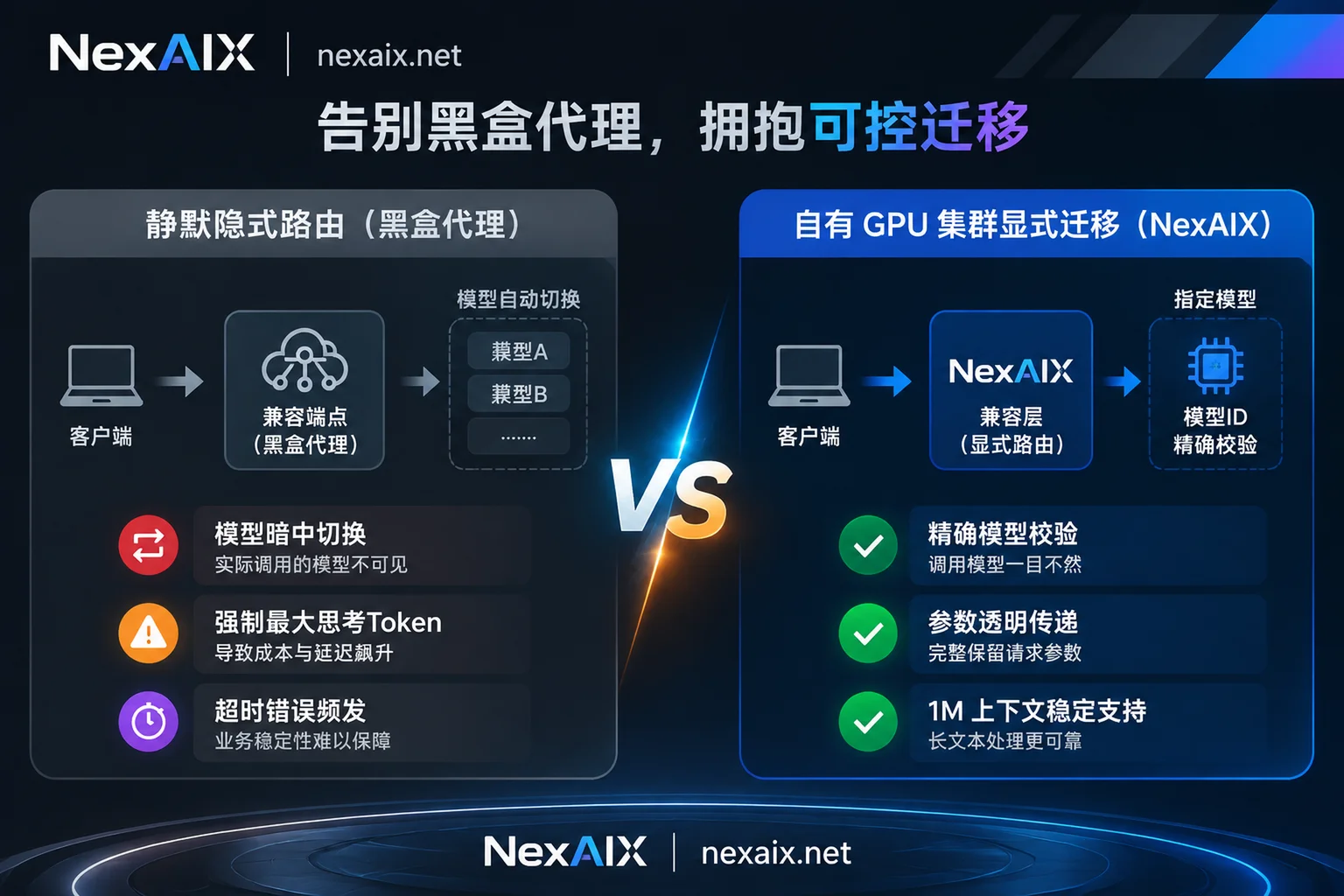
To save on cross-border settlement or self-hosted O&M, some teams try to access low-cost API aggregation channels. But as we analyzed in 《Don't Let "Black-Box" APIs Slow Down Agent Development: Building an Auditable, No-Downgrade Production-Grade Agent Foundation》, low-quality account pools and reverse-engineered relays often secretly downgradeM3requests to older small models during peak traffic, or forcibly truncate long contexts andmax_tokens. In addition, for enterprises with strict audit requirements, the lack of domestic compliance contracts, VAT invoices, and formal Data Processing Agreements (DPA) will put outbound codebase calls at risk of compliance red lines.
NexAIX's Solution: Self-Owned Compute Deployment + No Implicit Routing
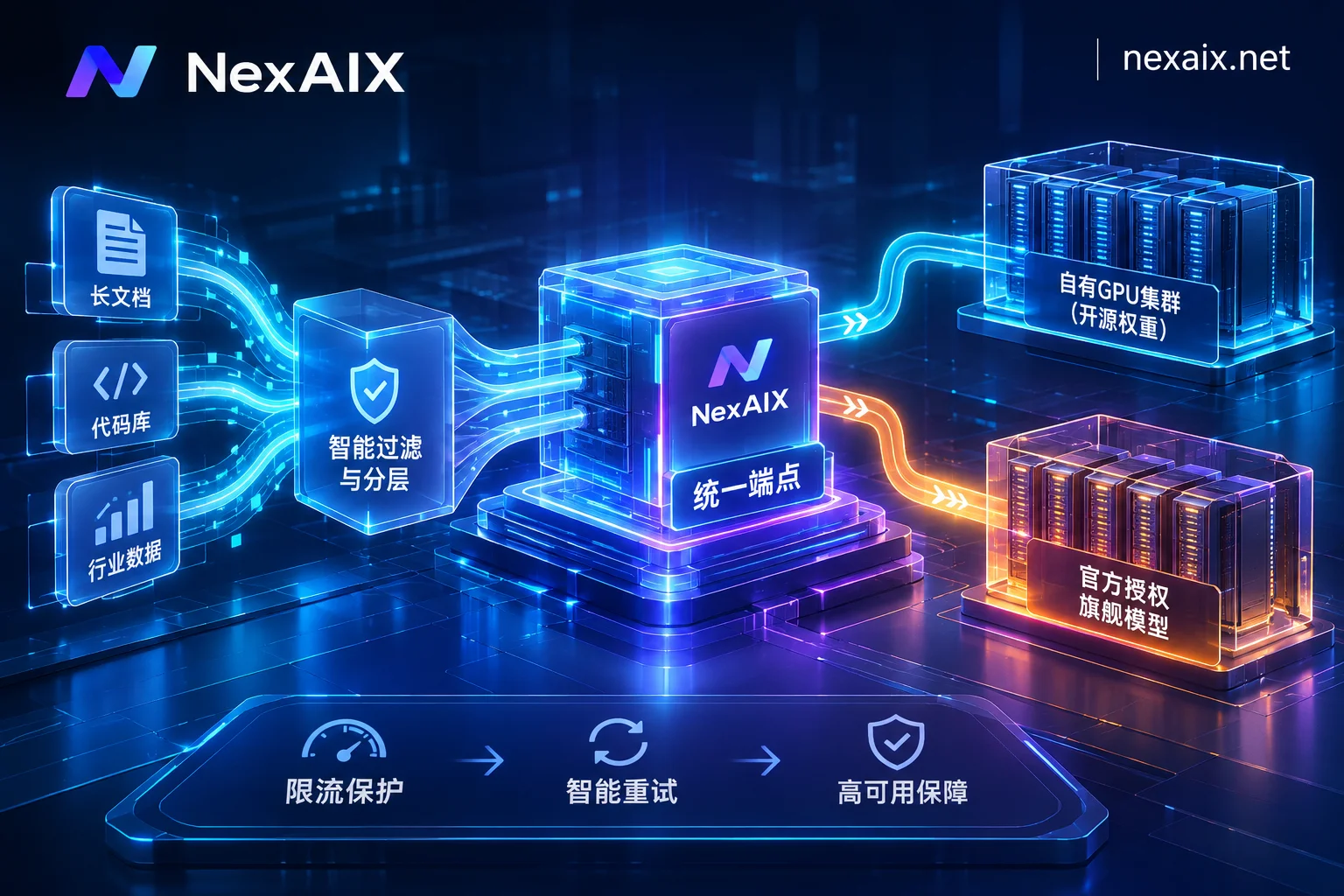
To address these pain points, NexAIX (nexaix.net) provides a production-grade solution that balances compute determinism and integration convenience:
- Self-Owned Compute Deployment (Open-Source Weights): We deploy open-source weight models released by MiniMax and other official sources directly on self-owned GPU clusters in self-built and leased data centers, fully operated and maintained by our own engineering team, and never resell uncontrollable third-party quotas. You can go directly to the Model Marketplace to view the currently available MiniMax series models. Each model detail page clearly indicates the "Self-Owned Compute Deployment" tag, model ID, context limit, maximum output, inference precision (e.g., BF16, FP8, MXFP4, etc., as actually labeled for the model), input modalities, and open-source license.
- Commitment to No Downgrade and Single Deterministic Response: Under the No-Downgrade and Verifiable Commitment, the
modelfield in NexAIX's response body is always the model actually executed. We do not provide or execute any "silent failover" or "automatic model switching"—no switching to smaller models, no lowering inference precision, no truncating context or maximum output, no injecting hidden system prompts; yourtemperature,top_p,max_tokensare passed through as-is. When the cluster experiences a sudden overload, the gateway will explicitly return a standard HTTP429status code with aRetry-Afterresponse header, never hanging the connection indefinitely, and never taking it upon itself to forward your M3 request to another model, returning 100% of the decision on retry, queuing, or switching to an alternative model to your business code.
Tip: If you need a specific version or an open-source weight model not yet listed during production migration, you can email the model name and estimated usage to [email protected]. Our compute team will evaluate and quickly reply with a schedule.
3. From M2.x to M3 Series: Complete OpenAI-Compatible Code Cutover in Three Steps
NexAIX strictly implements the interface according to the OpenAI Chat Completions specification, fully supporting streaming output, function/tool calling, and multi-turn conversations. For general principles of cross-version interface modification, you can refer to 《What Code Changes When Switching LLM APIs: Three Must-Change Configurations Plus Four Types of Parameter Compatibility Checks》.
The following uses the Python openai SDK as an example to demonstrate how to smoothly upgrade existing M2.x calls and support multimodality and tool calling.
1. Verify the Model Detail Page and URL Conventions
Before modifying the configuration, please visit https://nexaix.net/models/ to confirm the exact model identifier and parameter specifications of the target model. Note the URL concatenation rule for model pages on the site: the model detail page path https://nexaix.net/models/{slug}/ replaces the English period (.) in the model ID with a hyphen (-), but the model field passed in the API request body must still remain the original model ID as labeled on the model page.
2. Replace the Endpoint and Multimodal/Tool-Calling Practical Code
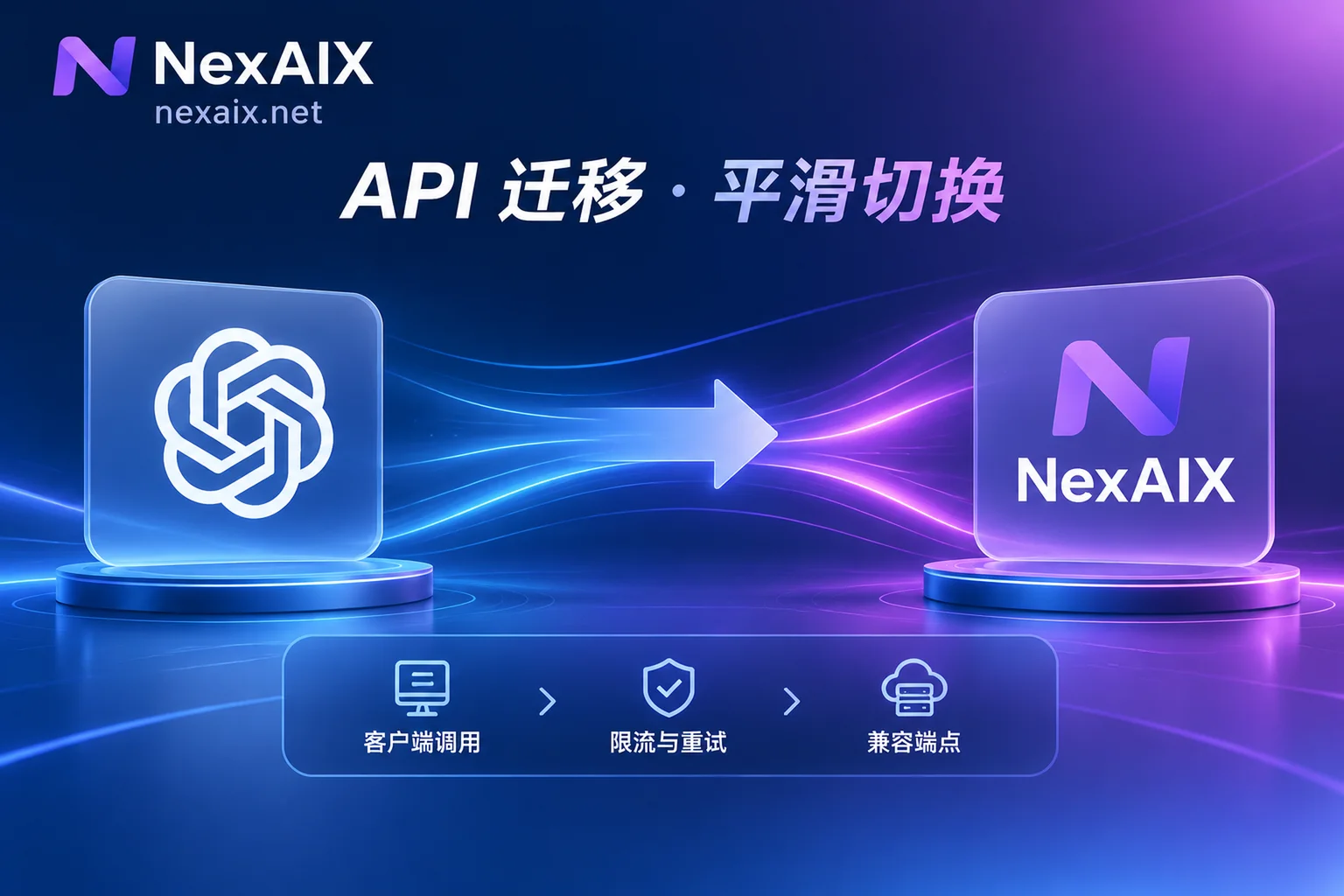
For projects already using the OpenAI SDK, simply point base_url to https://api.nexaix.net/v1 and replace the API Key obtained from the NexAIX Console (see the Three-Step Zero-Intrusion Integration Guide for details).
When migrating to MiniMax models that support visual understanding, images can be passed directly in image_url or Base64 encoding according to the OpenAI multimodal standard format, and videos can be passed as sequences of frames extracted as images:
import os
from openai import OpenAI

# 1. 统一使用 OpenAI 兼容端点,一把 Key 调用平台全部已开通模型
client = OpenAI(
    api_key=os.environ.get("NEXAIX_API_KEY"),
    base_url="https://api.nexaix.net/v1"
)

# 2. 定义 Coding Agent 的工具契约
tools = [
    {
        "type": "function",
        "function": {
            "name": "apply_code_patch",
            "description": "将生成的修复补丁应用到指定源码文件并运行单元测试",
            "parameters": {
                "type": "object",
                "properties": {
                    "file_path": {"type": "string", "description": "目标文件相对路径"},
                    "unified_diff": {"type": "string", "description": "标准 unified diff 格式补丁"}
                },
                "required": ["file_path", "unified_diff"]
            }
        }
    }
]

# 3. 发起包含报错截图(或视频抽帧序列)与长上下文代码的排障请求
# 注:具体在售 model 名称及支持模态请以 https://nexaix.net/models/ 模型页标注为准
response = client.chat.completions.create(
    model="minimax-m3",  # 请以模型页实际标注的 模型 ID 为准
    messages=[
        {
            "role": "system",
            "content": "你是一个资深全栈排障 Agent。请结合 UI 报错截图与代码上下文,直接调用工具提交修复补丁。"
        },
        {
            "role": "user",
            "content": [
                {"type": "text", "text": "前端控制台在渲染大表格时出现白屏,附上抽帧截图与核心组件代码:"},
                {
                    "type": "image_url",
                    "image_url": {"url": "https://example.com/debug-frames/frame_01.png"}
                }
            ]
        }
    ],
    tools=tools,
    tool_choice="auto",
    temperature=0.2,
    max_tokens=4096,
    stream=False
)

# 4. 校验实际执行的模型名并处理工具调用
print(f"实际执行模型: {response.model}")
message = response.choices[0].message
if message.tool_calls:
    for tool_call in message.tool_calls:
        print(f"触发工具: {tool_call.function.name}")
        print(f"参数载荷: {tool_call.function.arguments}")
If you use LangChain, LlamaIndex, Vercel AI SDK, or toolchains such as Dify, Cherry Studio, NextChat, Cline, OneAPI, you similarly only need to modify the custom OpenAI base_url to integrate seamlessly.
4. Production Canary Cutover and Stability Governance Checklist
To ensure a zero-failure switch before the November 18 shutdown deadline, technical leads are advised to implement the following four governance measures at the architecture level:
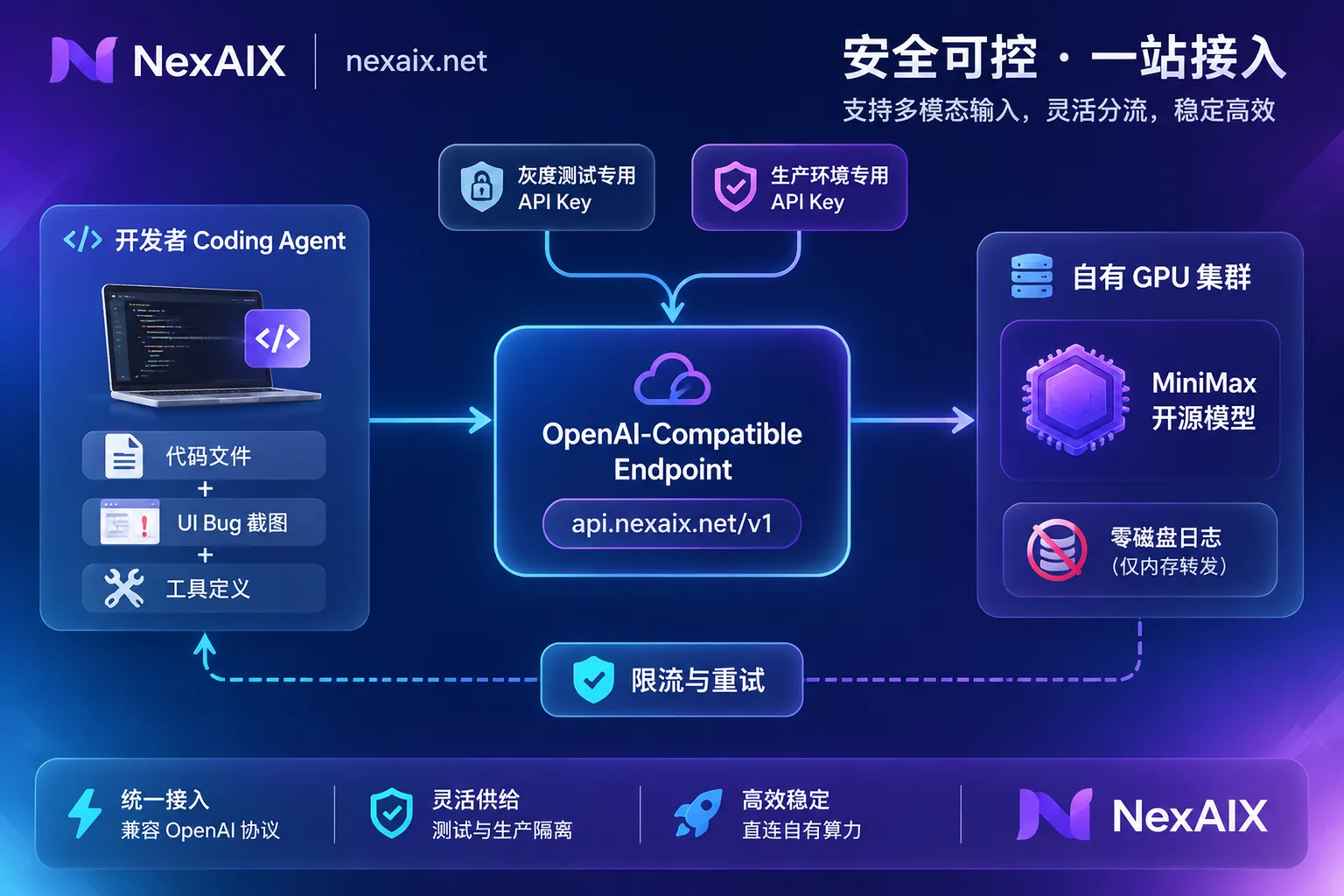
1. Use "Per-Key Isolation" to Implement Canary Comparison Between Old and New Models
During the migration validation period, never let online legacy business and new model stress-test traffic share the same API Key. In NexAIX, each Key has independent quotas, independent permissions, and independent usage billing (see Zero-Log and Key Isolation Mechanism for details).
- You can create a separate Key for the canary environment to run regression tests specifically for new MiniMax models;
- Billing is itemized by model, allowing precise calculation of changes in per-task token costs before and after migration;
- If a test environment Key is accidentally leaked in logs or frontend configuration, it can be revoked separately at any time without affecting the main production pipeline;
- Each call returns a unique Request ID. If you encounter abnormal status codes during parameter adaptation, contact technical support with the Request ID for quick troubleshooting.
2. Execute the Four-Step "Anti-Substitution and Anti-Downgrade" Baseline Verification
Before routing core production traffic to any API endpoint, it is recommended to perform a complete checkup according to 《How to Confirm Whether the API Returns the Original Model: Four Types of Reviewable Inspection Methods》 and the NexAIX No-Downgrade Self-Check Guide:
- Check the
modelfield in the response body: Confirm that themodelin the response JSON is completely consistent with the request, ruling out silent redirection; - Retest with fixed Prompt and random seed: Verify whether sampling parameters (
temperature,top_p) are passed through as-is; - Long-window boundary stress test: Initiate a test with a context length close to the model's nominal limit and
max_tokens, confirming there is no implicit truncation (note that for ultra-long inputs, first-token latency and cost naturally increase with input length); - Message repetition test: Ask the model to repeat all preceding messages it received, verifying that the gateway has not injected any interfering hidden system prompts at the underlying level.
3. Configure Explicit 429 Backoff and Cross-Model Primary/Backup Orchestration
Each Key has RPM (requests per minute), TPM (tokens per minute), and concurrency limits (if higher quotas are needed for business promotions or batch migration, you can contact us at any time to apply; we will respond based on actual cluster capacity; see High Throughput and Rate Limiting Explanation for details).
For fine-tuning rate-limiting thresholds, please refer to 《AI API Rate-Limiting Practical Troubleshooting and Architecture Governance: Breaking Down the Three-Dimensional Bottlenecks of RPM, TPM, and In-Flight Concurrency》. Since NexAIX adheres to the transparency principle of a single provider and a single endpoint, it will directly return standard 429 and Retry-After when fully loaded. In your business code's retry interceptor, you can leverage the feature of the same Key and the same endpoint: when the primary model triggers rate limiting or is in a maintenance window, simply change the model field in the request body explicitly at the application layer to DeepSeek, GLM, Kimi, Qwen on the same self-owned cluster, or Claude, GPT-5.6, Gemini series accessed through official authorized channels, achieving fully controlled client-side disaster recovery.
4. Implement Zero Retention of Code Assets and Enterprise Compliance Auditing
Coding Agents and R&D pipelines often involve core enterprise source code. As emphasized in 《AI API Privacy Compliance Practical Guide: Addressing Agent Data Leakage, Upstream Retention Disagreements, and Building Production-Grade Defenses》, when open-source weight models run on NexAIX's self-owned compute clusters, Prompts and Completions only flow in memory and are released immediately after the request ends, never written to disk; the platform only retains Request ID, model name, token count, timestamp, and status code for billing and troubleshooting, and uses TLS 1.3 encryption from client to inference node throughout; data is never used for training or handed over to third parties (view zero-log architecture details).
At the same time, NexAIX has a complete compliant entity, supports signing formal commercial contracts, issuing VAT invoices, and can sign Service Level Agreements and Data Processing Agreements (DPA); for strongly regulated scenarios such as finance and government/enterprise, you can also email [email protected] to discuss evaluation of dedicated resource pools and private deployment solutions.
5. Conclusion: Keep the Initiative of Model Upgrades in Your Own Hands
The retirement of MiniMax M2.5 and M2.7 marks the official full entry of long-horizon Agents and multimodal programming into the M3 generation with million-token contexts. In the face of upstream model version changes, rather than passively enduring parameter loss of control and timeout failures caused by implicit routing, it is better to take this opportunity to migrate the calling foundation to an engineering architecture with transparent specifications, autonomous compute, and unified interfaces.
Now you can go to the NexAIX Console (api.nexaix.net) and register with your email—no cumbersome enterprise qualification review required, test credits are granted upon registration. Spend five minutes replacing base_url and completing a round of canary stress testing, so that your Agent applications remain rock-solid before and after the November 18 shutdown deadline.