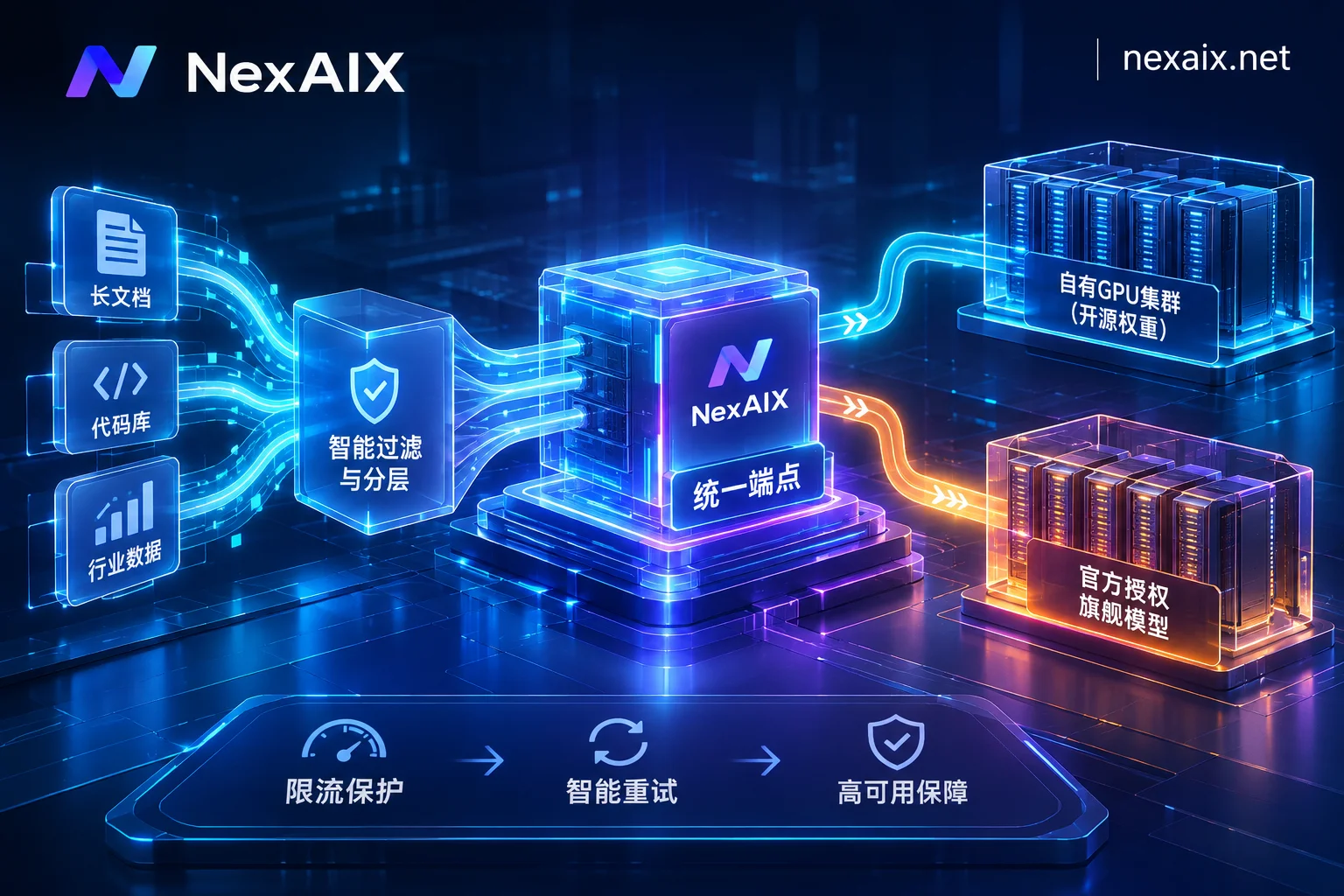
NexAIX-官方博客
Entering 2026, the parameter race in the large model field has pushed 128K and even 1M (million-level) token context windows into the mainstream standard. Whether processing a single government policy scan of tens of thousands of tokens, a financial research report system that reads hundreds of pages of PDFs at once, or a Coding Agent that refactors across an entire code repository, the long-context API frees the application layer from the cumbersome mechanical slicing of earlier days and grants an unprecedented 'global view'.
However, when technical teams actually push hundreds of thousands of tokens of Prompt into production, they often hit an invisible wall: models that were brilliant on short texts begin to frequently miss key constraints, frontend interfaces frequently disconnect due to gateway wait timeouts, and the monthly token bill shows exponential runaway. More and more architects realize: 'Physically being able to stuff 1M tokens' and 'stably and economically inferring 1M tokens in production' are completely different matters.
Previously, in the 'Long-Context API Production Deployment Guide: From VRAM Truncation Pitfalls and NIAH Recall Stress Testing to Hybrid Model Scheduling', we discussed basic recall testing and VRAM mechanisms. Today, standing at the latest application architecture evolution milestone of 2026, we take a different perspective—starting from Context Rot, Prefill first-token latency mechanisms, and the architectural game between RAG and long context—to dissect how to build a long-text engineering system based on NexAIX that truly withstands production traffic.
I. Breaking the Myth of 'Stuffing to the Brim': Three Hidden Reefs of Long Context in Production
Whenever model vendors release a larger window, there are always voices claiming 'RAG is dead, just stuff all documents into the Prompt'. But in real engineering deployment, brute-force 'Context Stuffing' is causing three core pain points:
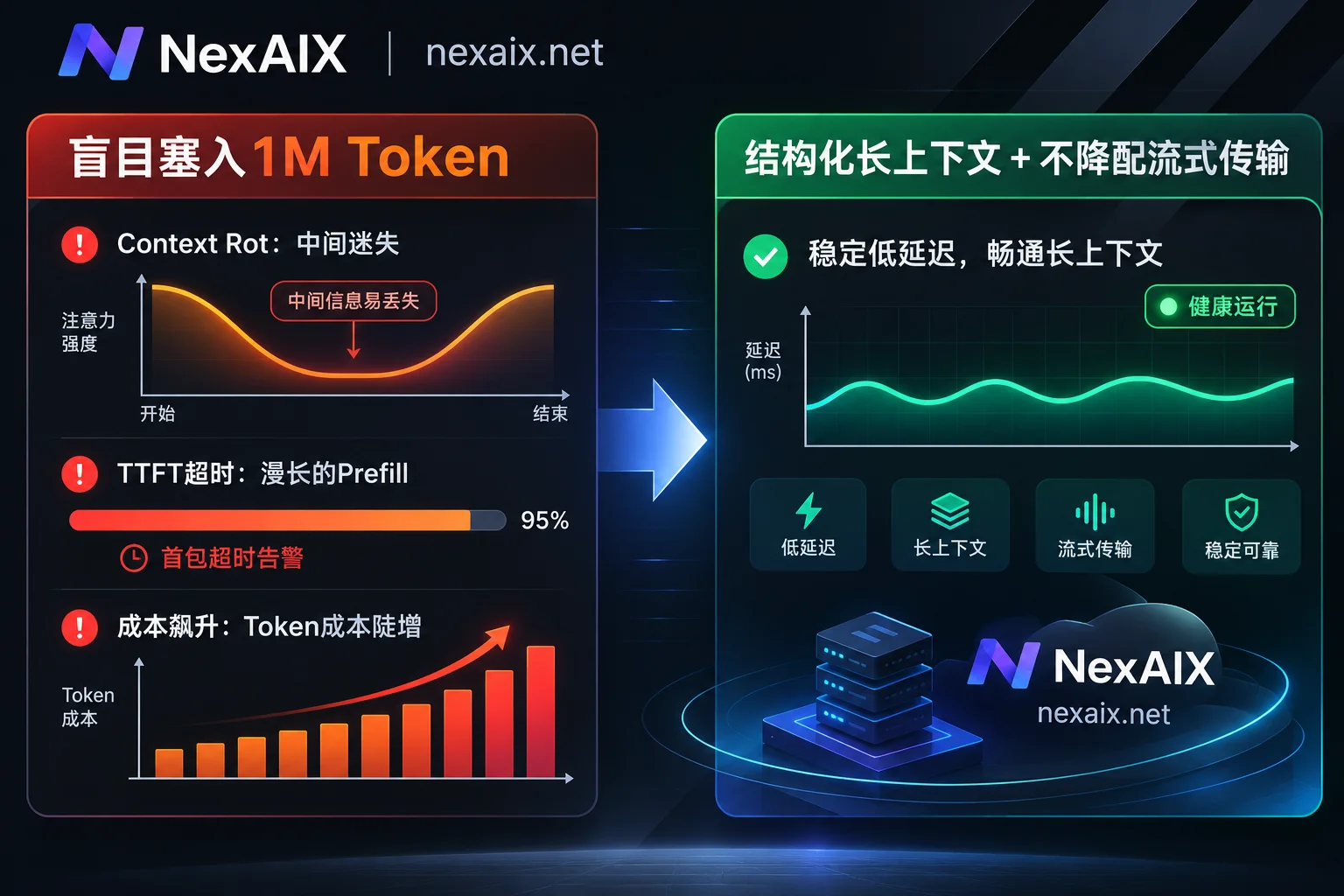
1. Context Rot and Multi-hop Reasoning Degradation
The industry's early 'Needle in a Haystack (NIAH)' tests often only examine literal retrieval of a single fact, and mainstream models generally score above 99% on such tests. But multiple engineering evaluations from 2025 to 2026 (such as Context Rot research and multi-hop benchmarks like NoLiMa and NeedleChain) reveal a harsh reality: as the number of input tokens increases, the model's attention distribution is severely diluted.
When a task requires logical association across page 15 and page 80 of a long document (multi-fact recall and chain reasoning), accuracy often plummets, and a large amount of information in the middle of the document falls into 'Lost in the Middle'. More fatally, if the accessed API channel privately performs low-bit quantization degradation or silent truncation on the model at the underlying level to save VRAM, this 'context rot' is dramatically amplified—the model superficially returns normal JSON, but it is actually built on incomplete context.
2. Prefill Computation Storm and Surge in TTFT (Time To First Token)
In interactive applications, the core metric for users perceiving system speed is not throughput (TPS) but TTFT (Time To First Token).
Large model inference consists of two distinct stages:
- Prefill stage: Processes all your input Prompt tokens in parallel, computes and generates a huge KV Cache matrix, then emits the first token.
- Decode stage: Uses the generated KV Cache to generate subsequent tokens one by one.
When you send a 200,000-token request through a long-context API, the server must undergo extremely heavy Prefill computation and VRAM bandwidth read/write before emitting the first character. Ultra-long input inevitably leads to a significant increase in first-token latency (TTFT) and per-request cost with input length. If the client still uses traditional non-streaming (Blocking) synchronous waiting, or the underlying provider adopts an 'indefinite queue hang' strategy when compute is fully loaded, it can easily breach the business gateway's Timeout threshold and cause a call chain avalanche (see 'Stable AI API Production Deployment Guide: Saying Goodbye to Agent Call Chain Avalanches, Implicit Degradation, and Hang Failures').
3. Single Request Saturating TPM Quota and Cost Cliff
Long context is a beast that devours compute quotas and budgets. On one hand, in the concurrency rate-limiting system, even if your request frequency (RPM) is low and you only initiate a few 100,000-token-level requests per second, you instantly saturate the TPM (Tokens Per Minute) and in-flight concurrency limit of a single Key; on the other hand, if each multi-turn conversation carries hundreds of thousands of tokens of historical background unchanged, the inference cost will be orders of magnitude higher than precise retrieval.
II. New Paradigm for Long-Text Architecture in 2026: Coarse-Grained Retrieval + Tiered Long-Window Inference
Facing the above hidden reefs, mature technical teams in 2026 no longer struggle with the binary opposition of 'choose RAG or choose long context', but have moved toward the engineering paradigm of 'hybrid context routing + multi-model tiered scheduling'.
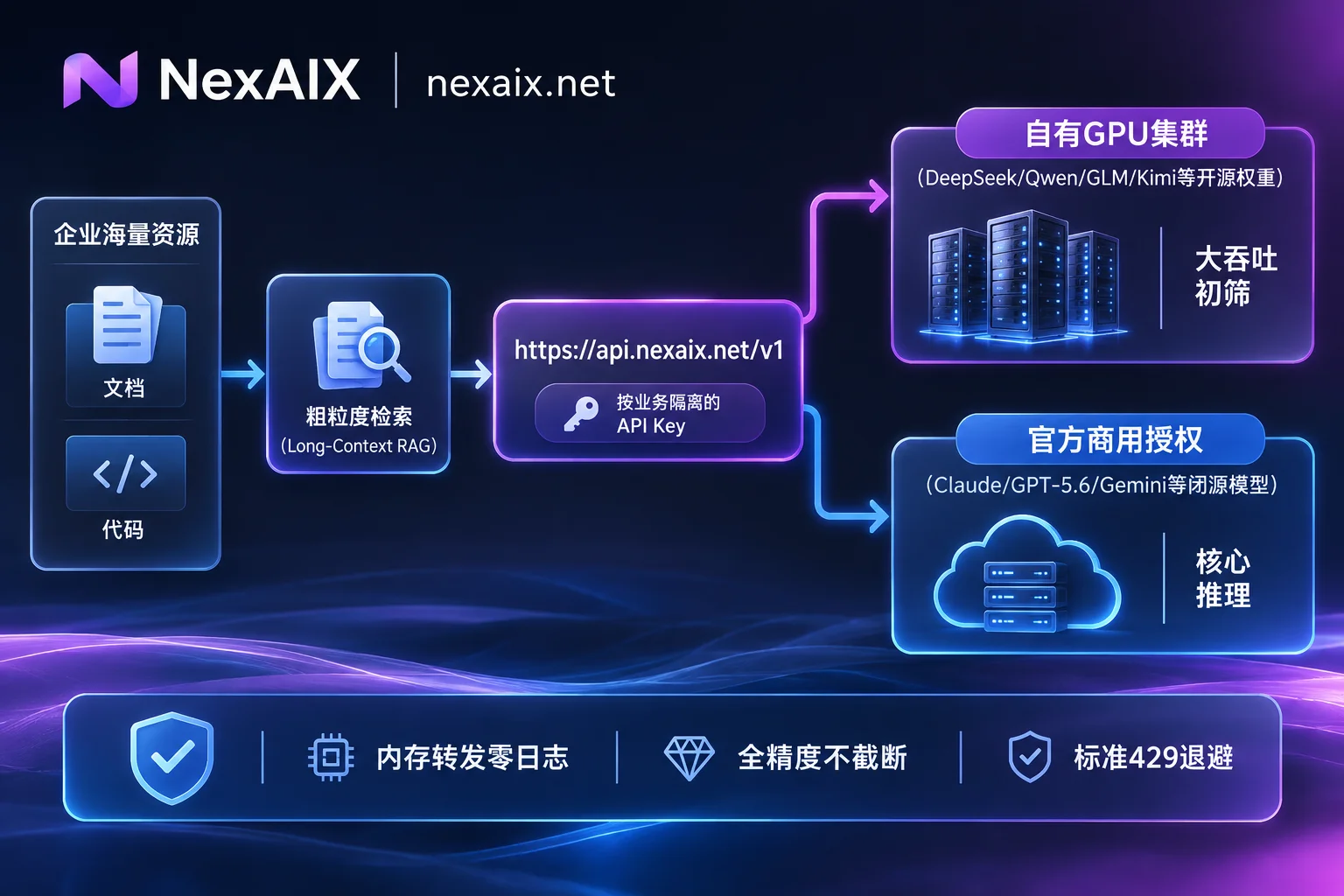
- Farewell to fragmented slicing, move to 'Long-Context RAG': No longer cutting documents into pieces (e.g., 256 tokens per segment), but using the retrieval layer (Embedding + Reranker) to filter out the most relevant entire chapters or complete code files (e.g., assembling 30,000–80,000 tokens of high-purity context), then handing them to the long-context API for global cross-paragraph reasoning. This avoids the Context Rot and high bills caused by blindly stuffing a million tokens, while retaining the complete logical chain of the long window.
Read-write tiering between open-source weights and closed-source flagships: Not all long-text tasks require calling the most expensive top-tier closed-source models.
- Massive material initial screening, structured extraction, and chunk summarization: These tasks have huge input and frequent calls, suitable for scheduling cost-effective open-source weight models (such as the DeepSeek, Qwen, GLM, Kimi, MiniMax, gpt-oss series listed in the NexAIX Model Plaza).
- Core logic adjudication, complex cross-document auditing, and final generation: The refined high-density context (or key 100,000-token case files) is handed to top-tier closed-source models (such as Claude, GPT-5.6, Gemini, Grok series) for final reasoning.
For this tiered architecture to run smoothly in production, the underlying API infrastructure must simultaneously possess unified protocol standards, transparent compute and precision guarantees, predictable rate-limit feedback, and strict privacy compliance boundaries. This is precisely the original design intent of NexAIX.
III. Why Do Production-Grade Long-Context Workflows Need the NexAIX Foundation?
In long-text scenarios, any 'little tricks' in the underlying relay will cause serious production incidents on the business side. NexAIX provides deterministic foundation support for long-context applications through four rigid engineering commitments:
1. Strictly Adhere to the 'No Degradation' Bottom Line: No Window Truncation, No Precision Reduction, Transparent Pass-Through
Some low-cost reverse or account pool relay stations on the market, when facing users' ultra-long context requests, silently truncate the middle of the Prompt at the gateway layer to prevent their own account pool from exceeding limits or to save VRAM, or secretly replace the request with a cheaper small-sized model or low-precision quantized version. This causes your long document analysis to 'seriously talk nonsense' without any error report.
Under the NexAIX Non-Degradation Guarantee System:
- True model and precision transparency: The
modelfield in the response body is the actually executed model; no swapping to smaller models, no precision reduction, never silently truncate context and maximum output, no injection of any hidden system prompts, and parameters such astemperature,top_p,max_tokensare passed through as-is. - Parameter specifications at a glance: On each independent model page of the NexAIX Model List (for example, visit
https://nexaix.net/models/glm-5-2/to view details ofglm-5.2; note that the slug rule in the URL is to replace dots in the model ID with hyphens), the model's supply method, context window upper limit, maximum output, inference precision (such as BF16, FP8, MXFP4, etc., marked according to actual deployment), and input modalities are clearly indicated. - Support four engineering self-checks: We encourage developers to directly stress test with lengths close to the upper limit, retest with fixed prompts and random seeds, verify the
modelfield in the response body, or ask the model to repeat all received messages, thereby verifying the integrity of the long window.
2. Transparent Dual-Track Supply: Own Compute Cluster + Official Commercial Authorization
Long context is extremely sensitive to VRAM capacity (KV Cache usage) and upstream quotas. NexAIX refuses account pools and reverse protocols, and only does two clean supply methods:
- Own compute deployment (open-source weights): For officially released open-source weight models such as Kimi, GLM, DeepSeek, MiniMax, Qwen, gpt-oss, we directly deploy them on our own GPU clusters in self-built and leased data centers, with independent operations and tuning, and do not resell third-party quotas. If the specific open-source long-text model you need is not in the current list, you can also send an email with the model and estimated usage to [email protected], and we will reply with a schedule after evaluating compute.
- Official authorized channels (closed-source models): For closed-source series such as Claude, GPT-5.6, Grok, Gemini, all go through vendor official commercial authorization, with contracts, invoices, and auditability.
3. Full-Model Streaming Output and Standard 429 Rate-Limit Contract
As mentioned earlier, the Prefill stage for ultra-long input takes a long time, and the first-token latency (TTFT) is naturally high. In NexAIX's Throughput and Rate-Limiting Mechanism:
- Full support for streaming output: All models support enabling
stream=Trueaccording to the OpenAI specification. Once the Prefill stage is over and the first token is generated, incremental content can be pushed to the client in real time, avoiding long connections being cut off by intermediate gateways due to excessive silence. - Refuse indefinite hanging, return standard 429: Each Key has independent RPM, TPM, and concurrency limits (higher quotas can be requested, replied according to actual capacity). When sudden long-text traffic triggers full load, NexAIX never hangs requests indefinitely, nor privately routes requests to cheaper models, but immediately returns a standard HTTP
429 Too Many Requestswith aRetry-Afterresponse header. Control is returned to your engineering code, and the business side clearly decides whether to backoff and retry per second, enter a queue, or explicitly switch to a backup model (for a deep dive into three-dimensional rate-limit governance, see 'AI API Rate-Limiting Practical Troubleshooting and Architecture Governance: Dissecting the Three-Dimensional Bottlenecks of RPM, TPM, and In-Flight Concurrency').
4. In-Memory Zero-Log Forwarding and Clear Compliance Boundaries
What is fed to the long-context API is often the enterprise's core code repository, unpublished financial reports, or internal legal contracts. If the API platform stores these Prompts of hundreds of thousands of words on disk, the risk of data leakage is immeasurable.
Under the NexAIX Zero-Log Privacy Defense Line, the entire process from client to inference node uses TLS 1.3 encryption; Prompt and Completion are only forwarded in memory and released immediately after the request ends, never written to disk; the platform only retains request ID, model name, token count, timestamp, and status code for billing reconciliation and troubleshooting, and never uses user data for training or transfers it to third parties.
At the same time, we remain absolutely honest about compliance: the above zero-log is the strict execution standard on our side; for closed-source models, data retention after requests reach upstream vendors is handled according to each vendor's terms (currently on this site's model pages, only the two Claude model pages separately state upstream retention: Opus 5 supports zero data retention, Fable 5 currently has 30-day retention; other closed-source models are subject to the official website and upstream real-time terms). If enterprise teams have extremely high data isolation and compliance audit requirements, NexAIX supports signing formal contracts, service agreements, and data processing agreements (DPA), and you can also contact [email protected] to discuss independent resource pools and private deployment evaluation (for more compliance details, see 'AI API Privacy Compliance Practical Guide: Dealing with Agent Data Leakage, Upstream Retention Disagreements, and Building Production-Grade Defense Lines').
IV. Practical Code: A Set of OpenAI-Compatible Interfaces for Long-Text Streaming Calls and Robust Backoff
NexAIX strictly follows the OpenAI Chat Completions specification. Whether you directly use the official OpenAI SDK or build long-text workflows through LangChain, LlamaIndex, Vercel AI SDK, Dify, Cline, etc., you only need to change base_url to https://api.nexaix.net/v1 and replace it with your NexAIX API Key to access all activated open-source and closed-source models with one Key.
Below is a production-grade Python practical code example demonstrating how to enable streaming transmission, monitor first-packet latency (TTFT) in real time, and strictly follow Retry-After for backoff and model switching when encountering full-load 429:
import os
import time
from openai import OpenAI, RateLimitError, APITimeoutError

# 仅需修改 base_url 与 api_key,即可无缝接入 NexAIX 统一底座
client = OpenAI(
    base_url="https://api.nexaix.net/v1",
    api_key=os.environ.get("NEXAIX_API_KEY"),
    # 超长输入 Prefill 耗时随长度上升,建议为连接与首包读取设置充裕的超时阈值
    timeout=180.0,
    max_retries=0  # 关闭默认黑盒重试,由业务层接管 Retry-After 与切模逻辑
)

def analyze_long_document(document_text: str, query: str, model_id: str, max_attempts: int = 3):
    """
    针对超长上下文的生产级流式调用封装:
    1. 强制开启 stream=True 缓解长 Prefill 带来的网关超时风险
    2. 记录 TTFT(首 Token 延迟)与实际返回的 model 字段以供自查
    3. 遵循 NexAIX 标准 429 与 Retry-After 头进行显式退避
    """
    messages = [
        {
            "role": "system",
            "content": "你是一名严谨的企业级文档分析专家。请严格基于用户提供的完整上下文回答问题,引用具体章节,切勿编造信息。"
        },
        {
            "role": "user",
            "content": f"【长文档上下文开始】\n{document_text}\n【长文档上下文结束】\n\n请回答:{query}"
        }
    ]

    for attempt in range(1, max_attempts + 1):
        try:
            start_time = time.perf_counter()
            first_token_time = None
            actual_model = None
            collected_chunks = []

            # 发起流式请求,参数原样透传
            stream = client.chat.completions.create(
                model=model_id,  # 例如切模型只需改此字段,如 "glm-5.2" 或其他在售模型 ID
                messages=messages,
                temperature=0.1,
                max_tokens=4096,
                stream=True
            )

            for chunk in stream:
                if first_token_time is None and chunk.choices and chunk.choices[0].delta.content:
                    first_token_time = time.perf_counter() - start_time
                    actual_model = chunk.model
                    # 生产自查:核对返回体里的 model 字段是否与请求一致
                    print(f"[监控] 首 Token 到达! TTFT: {first_token_time:.2f}s | 实际执行模型: {actual_model}")

                if chunk.choices and chunk.choices[0].delta.content:
                    content_piece = chunk.choices[0].delta.content
                    collected_chunks.append(content_piece)
                    # 实际业务中可在此处 yield 给前端 SSE 管道

            return "".join(collected_chunks)

        except RateLimitError as e:
            # 捕获标准 429 状态码,读取 Retry-After 响应头
            retry_after = 5
            if hasattr(e, "response") and e.response is not None:
                header_val = e.response.headers.get("Retry-After")
                request_id = e.response.headers.get("x-request-id", "unknown")
                if header_val and header_val.isdigit():
                    retry_after = int(header_val)
                print(f"[限流告警] 触发 RPM/TPM 满载 (Request ID: {request_id}),第 {attempt} 次退避,等待 {retry_after}s...")

            if attempt == max_attempts:
                raise RuntimeError(f"模型 {model_id} 连续达到配额上限,请申请更高配额或由业务层显式切换模型。") from e
            time.sleep(retry_after)

        except APITimeoutError as e:
            print(f"[超时告警] 超长上下文 Prefill 超时 (第 {attempt} 次尝试): {e}")
            if attempt == max_attempts:
                raise
Production Environment Multi-Key Governance and Cost Accounting Recommendations
When running the above long-text pipeline, because a single request consumes a huge amount of tokens, if 'long document batch preprocessing tasks' and 'online real-time customer service dialogue' share the same API Key, the batch task can easily consume the TPM quota instantly, causing online real-time dialogue to be blocked by 429.
With NexAIX's Per-Key Isolation and Billing Mechanism, technical leaders should create separate API Keys for different business lines (e.g., 'Offline Research Report Parsing' and 'Online Agent Interaction') in the console:
- Independent quotas and permissions: Each Key has an independent rate-limiting quota, so full load of offline long-text tasks will not affect online core links; once a Key is accidentally leaked, it can be individually revoked with one click.
- Itemized reconciliation by model: Billing details are clearly itemized by Key and specific model, and each call returns a unique request ID, making it possible to trace every transaction, whether troubleshooting abnormal latency of ultra-long input or calculating the true ROI of 'open-source initial screening + closed-source intensive reading' (see 'AI API Costs Can't Be Calculated? A Practical Breakdown from Hidden Premiums to Production-Grade Cost Control').
Conclusion: Build Long Context on Transparent, Controllable Infrastructure
The competition in long-context APIs in 2026 has long passed the primary stage of comparing paper window numbers. What truly determines whether enterprise AI applications can be robustly delivered in production is architects' engineering avoidance of Context Rot and first-token latency, and even more so the contract spirit of the underlying API platform in no degradation, no truncation, zero logs, and standard rate limiting.
If you are looking for a stable and reliable model foundation for long document processing, codebase-level Agents, or hybrid RAG systems, please visit the NexAIX Console to register with your email (no enterprise qualification required, test credits upon registration), select open-source weights and officially authorized closed-source models suitable for your business scenarios in the Model Center, and start a transparent, highly reliable million-context production journey with one Key.