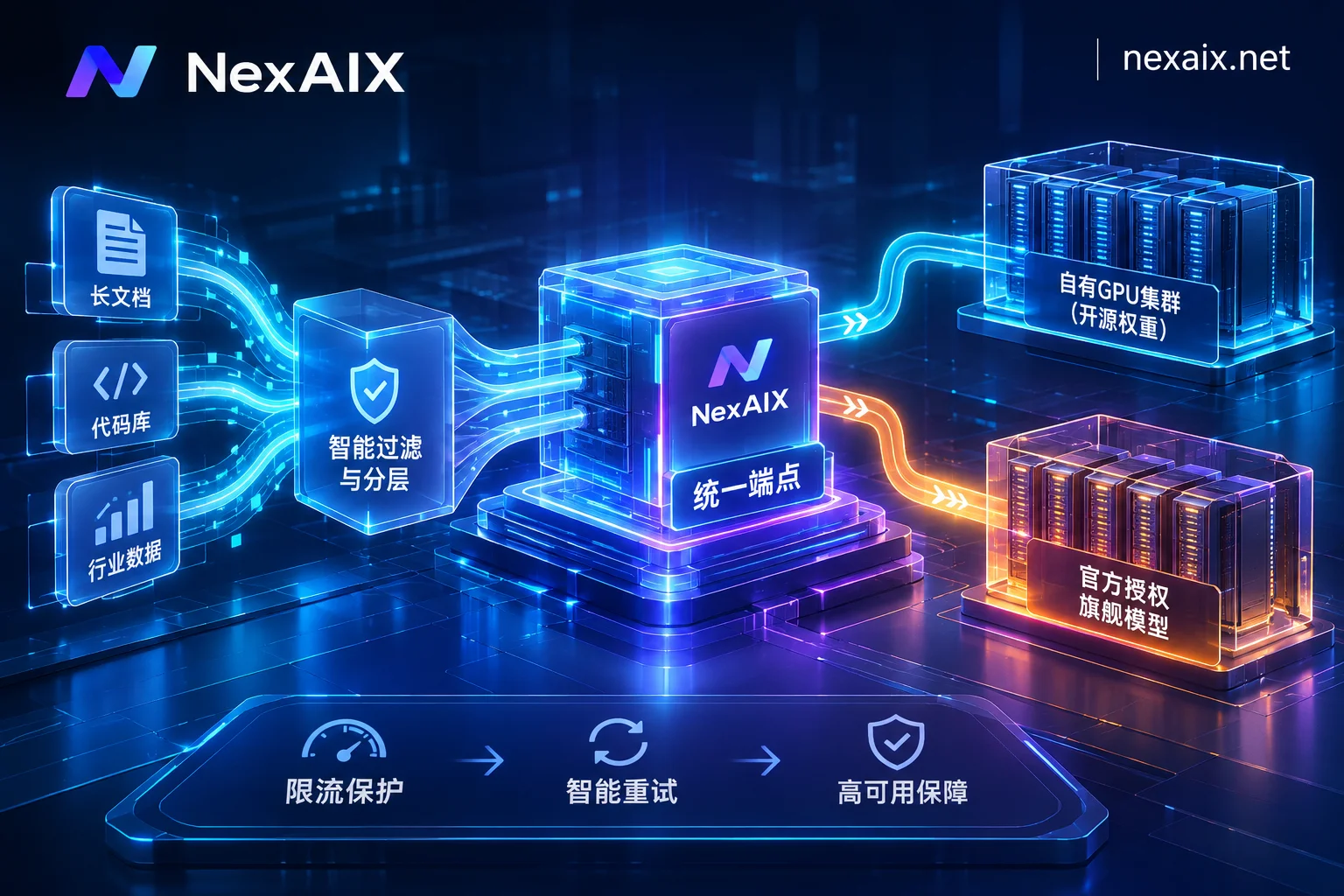
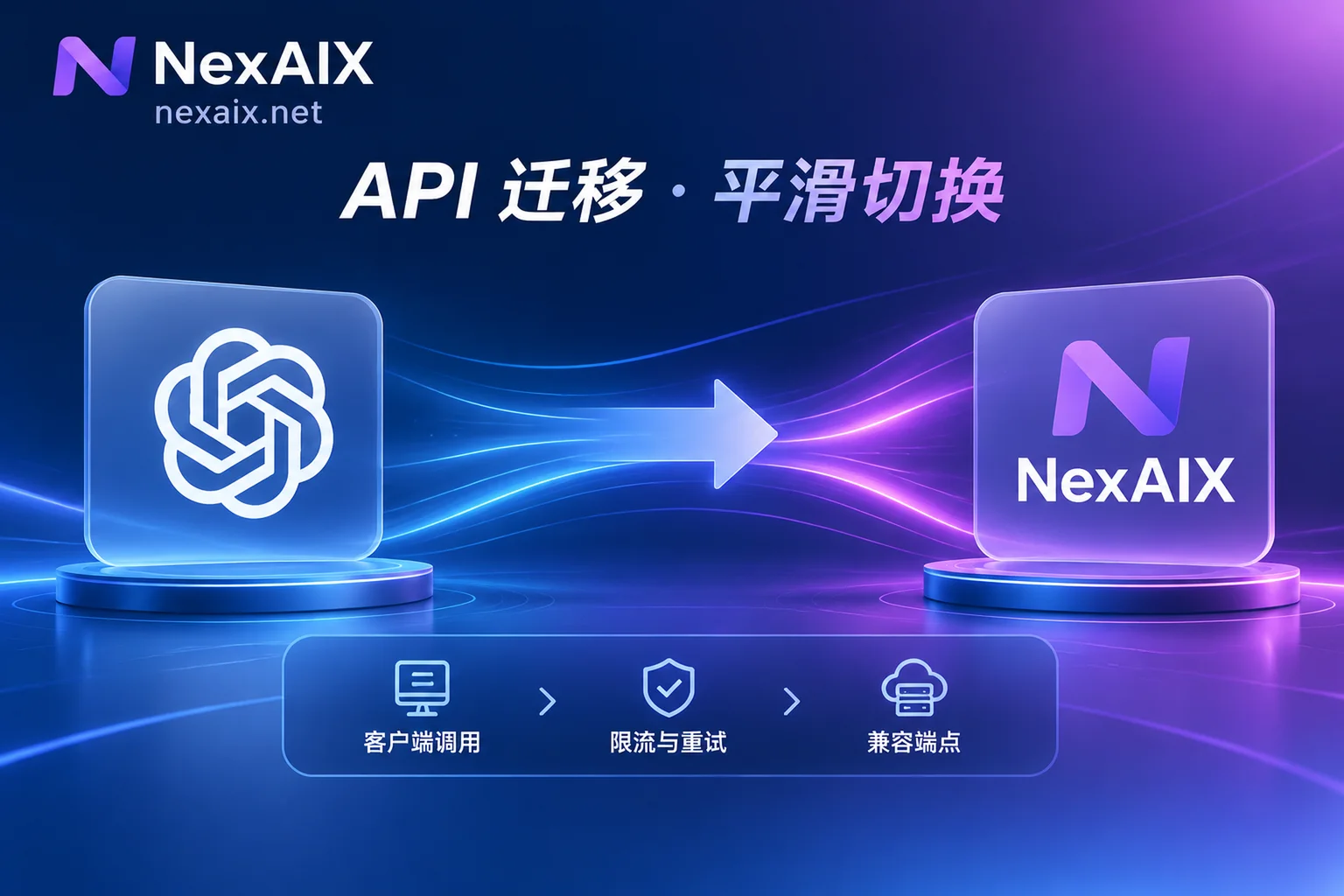
NexAIX-官方博客
In early November 2026, as Moonshot AI released the complete open weights of Kimi K3.1 Pro on Hugging Face as scheduled, and multi-agent hosting and collaboration architectures sparked a new round of heated discussions in the developer community, the core application scenarios of Kimi API have completely evolved from "single long-document Q&A" to "7×24 autonomous planning, cross-tool invocation, and long-running task delivery."
Whether it's pulling data from over a dozen sources in parallel to generate structured research reports in an investment research workflow, or mounting terminal tools in a development pipeline for cross-file code refactoring, current engineering teams are placing stricter demands on the Kimi family (from the 2.8T-parameter, million-token-context K3 and K3.1 Pro, to the K2.6 and K2.7 Code focused on coding and high-frequency scheduling). If you are handling migration work after the early API shutdown, you can first refer to our previous article "Kimi API Integration and Migration Guide: Responding to moonshot-v1 Shutdown, K3 and K2.7 Selection, and Self-Owned Compute Invocation".
This article will focus entirely on the deep waters of production-grade long-running Agents and high-frequency Tool Calls, dissecting why many teams, after successfully running local demos, encounter engineering pitfalls such as corrupted JSON structures, loss-making self-hosted VRAM accounting, authentication errors across domestic and international endpoints, and runaway multi-model billing once they push Kimi API to production, and provides verifiable architectural solutions.
1. Why does the same Kimi model show vastly different tool call performance across different channels?
In long-running Agent architectures, the value of a model no longer depends merely on "how well it writes," but on "whether it can precisely speak machine language." A complete long-running task often involves dozens of consecutive Function Calling rounds, and any missing parameter or type mismatch in any round will directly break the downstream business system's parser.
However, many developers have found in comparative tests that when requesting kimi-k2.6 or kimi-k3 series models, some low-cost API channels frequently return tool call results that fail. This is why the official team specifically open-sourced the K2-Vendor-Verifier (KVV) provider validation project to evaluate the real accuracy of different API providers in Tool Call scenarios.
Based on evaluation feedback and production troubleshooting experience, the root causes of Kimi tool call crashes caused by poor third-party channels are mainly concentrated in the following three points:
- Crude low-precision quantization and distilled model substitution: Open-source weight models have clear native precision standards when officially released (for example, Kimi K3.1 Pro uses quantization-aware training with MXFP4 weights + MXFP8 activations, while some models use BF16 or FP8). Some resale channels, in order to pack more concurrency onto a single machine, privately compress models into non-standard low-bit quantized versions, or even mix in smaller distilled models. This "shrinkage" at the compute level is hard to notice in ordinary chat, but in complex multi-tool selection it leads to blurred decision boundaries (randomly triggering APIs during chat, or missing tool calls under clear instructions) and JSON Schema constraint failure.
- Hidden prompt injection and silent context truncation: Long-running Agents rely on the complete reasoning chain (including the thinking process and historical tool return results) to maintain consistency in multi-step planning. Some black-box relay stations, in order to save VRAM overhead, silently truncate overly long historical messages at the gateway layer, or forcibly inject a global System Prompt, directly destroying the model's internal tracking of tool states.
- Post-processing parser tampering with parameters: Non-standard gateways often swallow or overwrite the
temperature,top_p, andmax_tokensparameters passed by developers when forwarding requests, causing uncontrollable random divergence in code and structured generation that originally required high determinism.
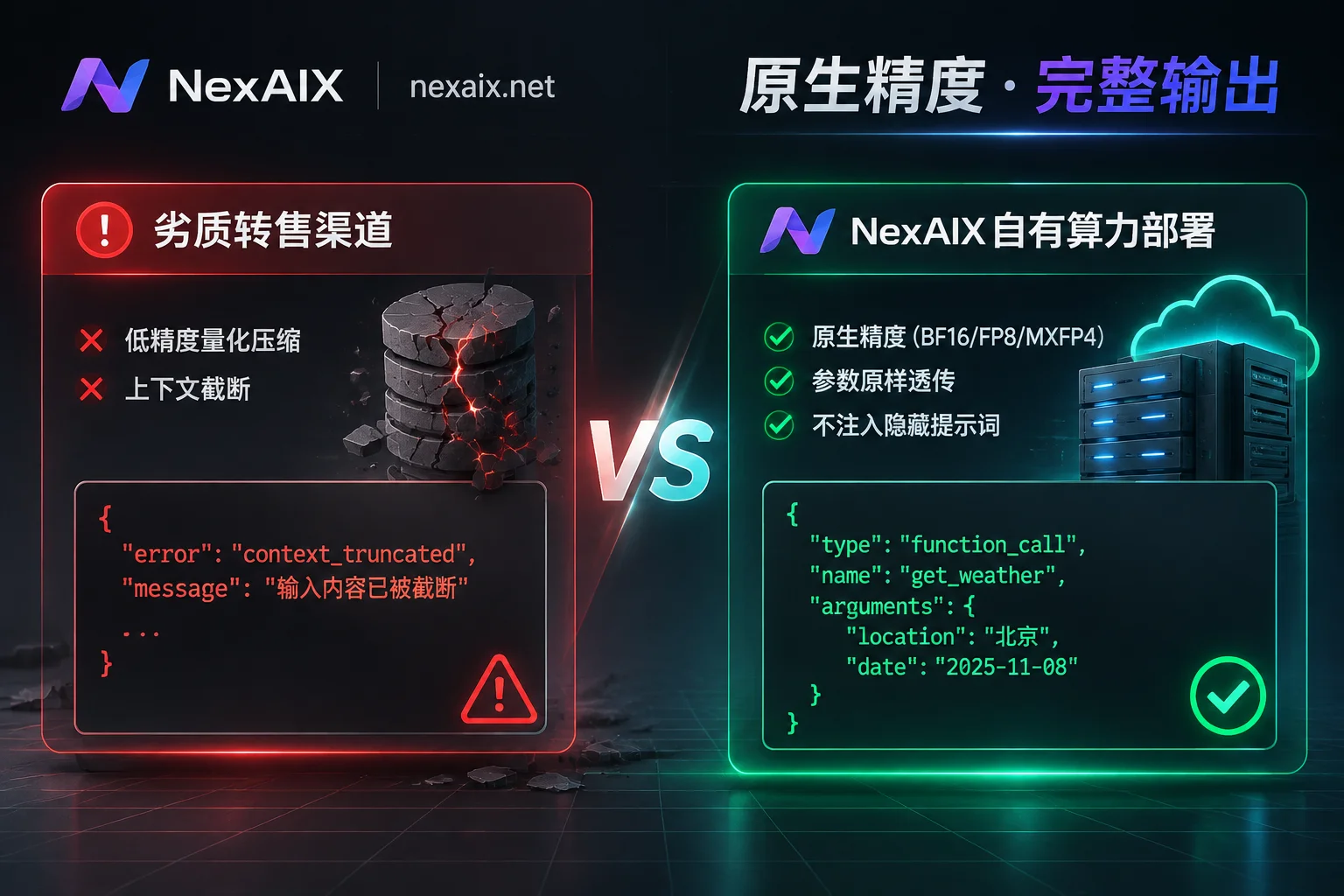
Production-grade solution: Self-owned compute deployment and a "no downgrade" transparent contract
To ensure the Kimi series models deliver stable production-grade performance in tool calls, the underlying compute must reject any form of "black-box modification" (for the auditability of the Agent底层, you can read further "Don't Let 'Black-Box' APIs Slow Down Agent Development: Building an Auditable, No-Downgrade Production-Grade Agent Foundation").
In the NexAIX Model Plaza, all open-source weight models, including the Kimi series, use self-owned compute deployment:
- Direct supply from self-built and self-leased data center clusters: We deploy the officially released open-source weights directly on our own GPU clusters, operated and maintained directly by our own engineering team, and never resell uncontrollable third-party second-hand quotas. Each model detail page (in the format
https://nexaix.net/models/{slug}/; note that the slug in the URL requires replacing dots in the model ID with hyphens) clearly indicates the model's supply method, context length, maximum output, inference precision (such as BF16, FP8, MXFP4, etc., strictly as labeled for the model), and open-source license. If you need to integrate a specific open-source weight model not in the list (such as a newly released specific snapshot version), you can also directly specify the model and estimated usage and email [email protected]; we will evaluate the compute and reply with a schedule. - Strictly implement the no-downgrade commitment: The
modelfield returned in the response body strictly corresponds to the model actually performing inference; no switching to smaller models, no precision reduction, no truncation of context or maximum output, no injection of any hidden system prompts, and thetemperature,top_p, andmax_tokensin requests are passed through as-is.
Developers can use the four methods published on our no-downgrade explanation page to conduct online self-checks at any time:
- Use fixed prompts and random seeds for cross-batch retest comparisons;
- Check the
modelfield in the response body against actual capability characteristics; - Construct ultra-long contexts close to the model's nominal limit for needle-in-a-haystack (NIAH) stress testing;
- Directly instruct the model to fully repeat all system and user messages it received, to verify whether there is hidden injection.
2. The self-deployment accounting for 1.56TB weights: Build your own GPU cluster or call self-owned compute APIs?
Whenever Kimi releases a new generation of open weights (such as the recently released Kimi K3.1 Pro), many technical leads face a soul-searching question from management or finance: "Since the weights are already freely open-sourced and there are no license barriers for internal commercial use, why should we pay API bills by token instead of renting GPUs and deploying it ourselves?"
As overseas cloud cost analysis firms (such as CloudZero and Spheron) recently pointed out in their 2026 open-source model cost reports: "Free weights" are often the most expensive free thing in software engineering.
Taking the just-released Kimi K3.1 Pro as an example, we can do a real hardware and operations accounting:
- Storage and VRAM hard thresholds: The base weight files alone contain 96
safetensorsshards, occupying up to 1.56 TB of disk space. Even with the native MXFP4 weight + MXFP8 activation format, to fully load the weights and reserve sufficient KV Cache VRAM for million-token long contexts, a single machine cannot accommodate it at all; you must directly use multi-machine multi-GPU (such as high-performance H200 or B200 nodes) with high-speed InfiniBand interconnect architecture. - Idle Cost: Self-built or long-term leased GPU clusters are billed by "GPU-hour"—whether or not there are business requests at 3 a.m., the cluster is burning high rental and electricity costs every second. Industry estimates show that unless your team can maintain extremely high and absolutely smooth steady-state throughput of hundreds of millions to tens of billions of tokens per day, the redundant compute reserved for peak demand in a self-built cluster will make the true amortized cost per effective task far higher than a pay-as-you-go Serverless API.
- High AI Infra operations tail costs: For ultra-large-scale MoE architectures, building your own inference engine, tuning Gated sparse attention operators, and handling multi-node communication failures require a full-time team of low-level inference engineers (for a breakdown of multi-source heterogeneity and self-hosting burdens, see "Unified Access and Production Architecture Guide for Multiple Open-Source Large Model APIs: Saying Goodbye to Multi-Client Fragmentation and Self-Hosting Operations Burden").
By directly accessing NexAIX's self-owned compute endpoints, R&D teams effectively avoid the fixed asset investment and operations burden of 1.56TB-level multi-machine clusters, and directly enjoy full-precision open-source model compute in a lightweight pay-per-token model.
3. Cross-border endpoint fragmentation and data privacy red lines: Compliance solutions for enterprise deployment
When introducing Kimi API into enterprise internal productivity tools, financial investment research systems, or code assistants, architects often hit two other walls: fragmented connection management and divergent data retention compliance.
1. Say goodbye to the endpoint fragmentation of .cn and .ai
Many developers who have struggled with direct connection configurations have fallen into the "valid Key returns 401 error" trap: the direct connection ecosystem has two independent platform and account systems—domestic (.cn) and international (.ai)—and the API Keys and request root addresses of the two sides must not be mixed. If a R&D team has both domestic and overseas hybrid deployment nodes and also needs to mix Claude, GPT-5.6, DeepSeek, or GLM models in business flows, maintaining multiple domains, multiple prepaid balances, and multiple authentication logics will quickly become a configuration disaster.
2. The "zero data retention" requirement for core assets
In financial analysis, legal contract review, and private codebase scanning scenarios, prompts contain large amounts of undisclosed financial data, core business logic, and customer privacy. Third-party evaluation and cost tracking firms (such as Spheron in its 2026 comparison report) have reminded developers to pay attention to default data usage rules and training exemption clauses in direct API terms. For enterprises subject to strict compliance audits, any risk that "conversation content may be stored or used for model training" is a veto item.
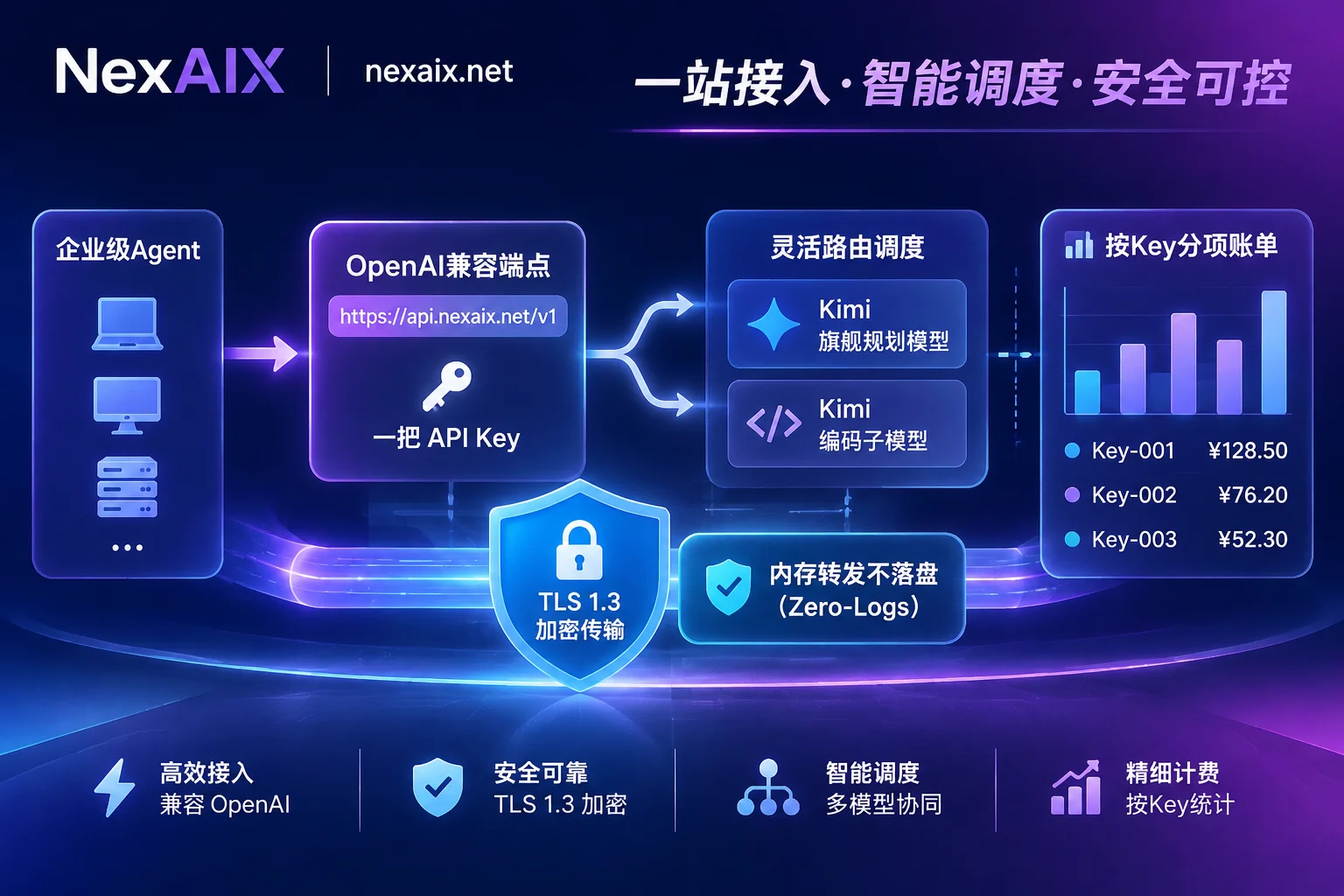
Production-grade solution: Zero-log in-memory forwarding + mixed-model scheduling with one Key
In response to the above compliance and architecture pain points, NexAIX has built clear isolation defenses at the gateway and compute layers (for a complete explanation of channel transparency, please refer to the Supply Method and Self-Check Guide):
- Full-chain no conversation logging for open-source models: On the NexAIX side, all requests'
promptandcompletionare forwarded only in memory and released immediately after the request ends, never written to disk; they are not used for any model training, nor handed over to third parties that do training; the entire transmission from client to inference node uses TLS 1.3 encryption. The system retains only metadata for billing and troubleshooting (request ID, model name, token count, timestamp, status code). Since open-source weight models such as Kimi run directly on NexAIX's own GPU clusters, there is no external upstream vendor link, so your code and document data are under strict "burn-after-inference" protection throughout the inference lifecycle. - Open-source and closed-source mixed scheduling, with honest and transparent boundaries: If your multi-agent architecture not only needs Kimi to process long documents but also needs to link closed-source flagship models (such as Claude, GPT-5.6, Grok, Gemini series), NexAIX also provides access through officially authorized channels (with formal commercial contracts, invoices, and auditability; never using personal account pools or reverse-engineered client protocols). For closed-source models, we also honestly disclose the boundaries: our site also does not store data, but after requests reach upstream vendors, they are handled according to each vendor's terms (currently only two Claude model pages on the official website separately note upstream retention: Opus 5 supports zero data retention, Fable 5 currently has 30-day retention; other closed-source models are subject to the official website and corresponding vendor policies).
- Enterprise-level business and private deployment support: NexAIX has a complete legal entity, supports signing formal service agreements and data processing agreements (DPA), and issues VAT invoices; for scenarios with extreme physical isolation compliance requirements, you can also directly contact [email protected] to discuss independent resource pools or private deployment evaluation.
4. Production-grade long-running Agent architecture in practice: Three-step integration, tiered cost control, and 429 resilience governance
In multi-agent collaboration scenarios (such as "master planning Agent + multiple vertical execution sub-Agents"), if all steps indiscriminately call the most expensive trillion-parameter flagship model, the token bill will expand exponentially. A more reasonable production practice is same-family/cross-family hybrid tiered scheduling:
- Master planning and million-word material reading: Assign to flagship models with ultra-large context and deep reasoning capabilities (such as the Kimi K3 series) for global task decomposition and final quality inspection;
- High-frequency code patching and subtask execution: Distribute to coding or lightweight specialized models with extremely fast response and more cost-effective pricing (such as K2.7 Code, K2.6, or GLM, DeepSeek series).
With NexAIX's OpenAI-compatible integration standard, you don't need to introduce multiple SDKs for different models; just one endpoint, one Key, and by dynamically modifying the model field in requests, you can achieve smooth routing.
1. Zero-modification integration code example (Python)
Whether you use the native OpenAI SDK or mainstream frameworks and clients such as LangChain, LlamaIndex, Vercel AI SDK, Dify, Cherry Studio, Cline, NextChat, OneAPI, etc., you only need to point base_url to https://api.nexaix.net/v1 and replace it with the API Key obtained from the NexAIX Console (register with email to get test credits, no enterprise qualification required):
import os
import json
from openai import OpenAI

# 1. 统一使用 OpenAI 兼容端点,一把 Key 调度全平台开源与闭源模型
client = OpenAI(
    base_url="https://api.nexaix.net/v1",
    api_key=os.environ.get("NEXAIX_API_KEY")
)

# 定义提供给 Kimi Agent 的工具契约 (Function Calling)
tools = [
    {
        "type": "function",
        "function": {
            "name": "query_financial_filing",
            "description": "检索指定上市公司的财报核心指标与原文段落",
            "parameters": {
                "type": "object",
                "properties": {
                    "ticker": {"type": "string", "description": "股票代码,如 AAPL 或 00700.HK"},
                    "metric": {"type": "string", "description": "财务指标名称,如 自由现金流、研发费用"},
                    "year": {"type": "integer", "description": "财报年份"}
                },
                "required": ["ticker", "metric", "year"]
            }
        }
    }
]

def run_agent_step(messages, model_id):
    """
    执行单步 Agent 推理,支持传入不同 model_id 实现主从模型分层调度
    注意:具体在售的 model_id 请以 https://nexaix.net/models/ 实时列表为准
    """
    response = client.chat.completions.create(
        model=model_id,
        messages=messages,
        tools=tools,
        tool_choice="auto",
        temperature=0.1,  # 原样透传,确保工具调用 JSON 参数的高确定性
        max_tokens=4096
    )

    # 验证不降配:返回的 model 字段即为实际执行的模型
    print(f"[Audit] 实际执行模型: {response.model} | 请求ID: {response.id}")
    return response.choices[0].message
Routing troubleshooting tip: When checking the NexAIX model list, please note the distinction between the slug in the webpage URL and themodelparameter in code. The URL of a single model introduction page replaces the English period (.) in the model ID with a hyphen (-); for example, visithttps://nexaix.net/models/glm-5-2/to view documentation and three-step integration code (directly spelling/models/glm-5.2/will return 404), but in themodelfield of the Python code above, you should still fill in the real model ID as labeled on the page.
2. Deterministic governance of high-concurrency rate limiting (429) and long-input latency
When a multi-agent workflow fans out dozens of subtasks in parallel, it can easily instantly saturate a single Key's RPM (requests per minute), TPM (tokens per minute), or in-flight concurrency limit (for a deeper breakdown of the three-dimensional rate limiting bottleneck, we recommend reading "AI API Rate Limiting Troubleshooting and Architecture Governance: Breaking Down the Three-Dimensional Bottleneck of RPM, TPM, and In-Flight Concurrency").
In production environments, the most fatal thing is not an error, but "silent hanging" or "covert degradation." NexAIX's high-throughput and rate limiting strategy adheres to deterministic engineering principles:
- Reject false deadlocks and model switching: When a request hits the quota limit or compute is saturated, the gateway immediately returns a standard HTTP
429 Too Many Requestsstatus code and includes a clearRetry-Afterwait time suggestion in the response header; it never hangs the connection indefinitely and drags down your worker thread pool, nor does it secretly switch the request to a cheaper smaller model in the background to mask saturation (our site uses a single-provider, single-endpoint architecture without implicit automatic failover, leaving backoff retries or traffic switching logic entirely under business control). - Ultra-long input and streaming keep-alive: When feeding Kimi ultra-long documents of hundreds of thousands or even millions of tokens, time-to-first-token (TTFT) and compute costs naturally rise with input length. It is recommended to fully enable streaming output in production code (
stream=True); all NexAIX models support standard streaming responses, which can effectively prevent client load balancers or reverse proxies from actively disconnecting TCP connections due to waiting too long for the first packet. - Elastic scaling requests: If your business encounters major promotions or batch processing peaks and the default quota of your existing Key is insufficient, you can directly contact us to apply for a higher quota; the engineering team will quickly evaluate and respond based on the actual capacity of our own clusters.
3. Cost accounting and fault localization with per-Key isolation
In complex Agent systems, to figure out whether the "investment research summary module" or the "code review module" consumes most of the budget (see "AI API Cost Optimization in Practice: From Agent Multi-Model Tiering and Hidden Cost Troubleshooting to Multi-Key Billing Governance"), we strongly recommend using NexAIX's per-Key isolation mechanism:
- Create separate API Keys for different Agent microservices and different development environments (Dev / Staging / Prod);
- Each Key has independent quotas, independent permissions, and independent usage bills, and bills support itemized statistics by model; log in to the console to export usage details at any time;
- If a Key for a frontend plugin or test environment is accidentally leaked, it can be revoked separately without affecting the core production pipeline at all;
- Each API call returns a unique request ID (Request ID); when encountering any abnormal status code online, simply provide that request ID to contact technical support, and second-level link troubleshooting can be completed without touching any conversation content.
Conclusion: Leave the underlying compute to deterministic infrastructure, and leave your energy for Agent business logic
From the early long-text readers to today's complex multi-agent collaboration networks driven by Kimi K3.1 Pro, K3, and K2.6/K2.7 Code, the evolution of the Kimi model family is making more high-value end-to-end automated delivery a reality. In this race for engineering deployment, the underlying API infrastructure should not be the weak link that secretly reduces quantization precision, arbitrarily changes tool call parameters, or burdens the team with heavy GPU operations.
If you want to directly call the Kimi series models with self-owned compute deployment, native precision without downgrades, and zero-log in-memory forwarding in production, and achieve same-endpoint hybrid orchestration with mainstream global open-source and closed-source large models, welcome to immediately visit the NexAIX Console to register an account with your email (register to get test credits, no enterprise qualification required), or check the latest available specifications at the Model Plaza, and start a highly reliable Agent production journey with three lines of configuration.