NexAIX-官方博客
In 2026 AI engineering practice, developers calling the GPT API have long moved far beyond simple "multi-turn text Q&A." With the spread of automated workflows, data cleaning pipelines, and complex Agent systems, the real role large models play in backend architectures is "turning unstructured intent into type-safe API contracts."
Recently in developer communities, high-frequency engineering discussions have focused on how to correctly draw the contract boundary between Function Calling and Structured Outputs in production, and how to handle JSON parsing exceptions during cross-model migration. At the same time, as industry discussion heats up around automated execution and code safety boundary evaluations (such as the latest safety models pushing out-of-bounds invocation rates to extremely low levels), technical leaders increasingly realize: an interface that merely "chats like a human" has no production value; only a GPT API that strictly adheres to Schema constraints, accurately triggers external tools, and has auditable behavior is the cornerstone of system stability.
However, many teams get a Demo running locally, but once they push services that deeply rely on function calling and JSON parsing into production, they often encounter thorny failures such as occasional parser crashes, mysteriously missing tool parameters, and long JSON truncated midway. This article explores how to run the GPT API's structured capabilities reliably in production from three dimensions: engineering contract design, hidden failure troubleshooting, and hybrid model architecture.
1. Clarify the Contract Boundary: When to Use Structured Outputs and When to Use Function Calling?
In daily code reviews, one of the most common anti-patterns is mixing Function Calling with structured formats—for example, deliberately defining a fake return_json_result tool to make the model "call" it just to get back a fixed-format JSON object; or conversely, hand-writing a large JSON format requirement in the system prompt and expecting the model to direct downstream microservices using plain text.
Under the standard OpenAI Chat Completions specification, these two solve control problems at completely different stages:
- Structured Outputs (fixed-format responses): data shaping at the endpoint
When your application does not need the model to trigger any external action and only needs it to put analysis results (such as invoice field extraction, ticket classification labels, or sentiment score cards) directly into a database or render them to the frontend UI, you should constrain its response format. At this point the model is at the endpoint of the workflow, and the core requirement is "complete fields, matching types, and not a single extra word." - Function/Tool Calling (Function Calling): action routing during the process
Only when the model needs to proactively request real-time data from your application (such as querying inventorylookup_stock), or ask the business system to perform a state change (such as creating a ticket or sending an email), should you use thetoolsfield to declare functions. At this point the model is the decision hub of the workflow: it must decide on its own whether to call a tool, which tool or tools to call, assemble parameters according to the tool's Schema, wait for the host program to execute and return results, and then continue multi-turn reasoning.
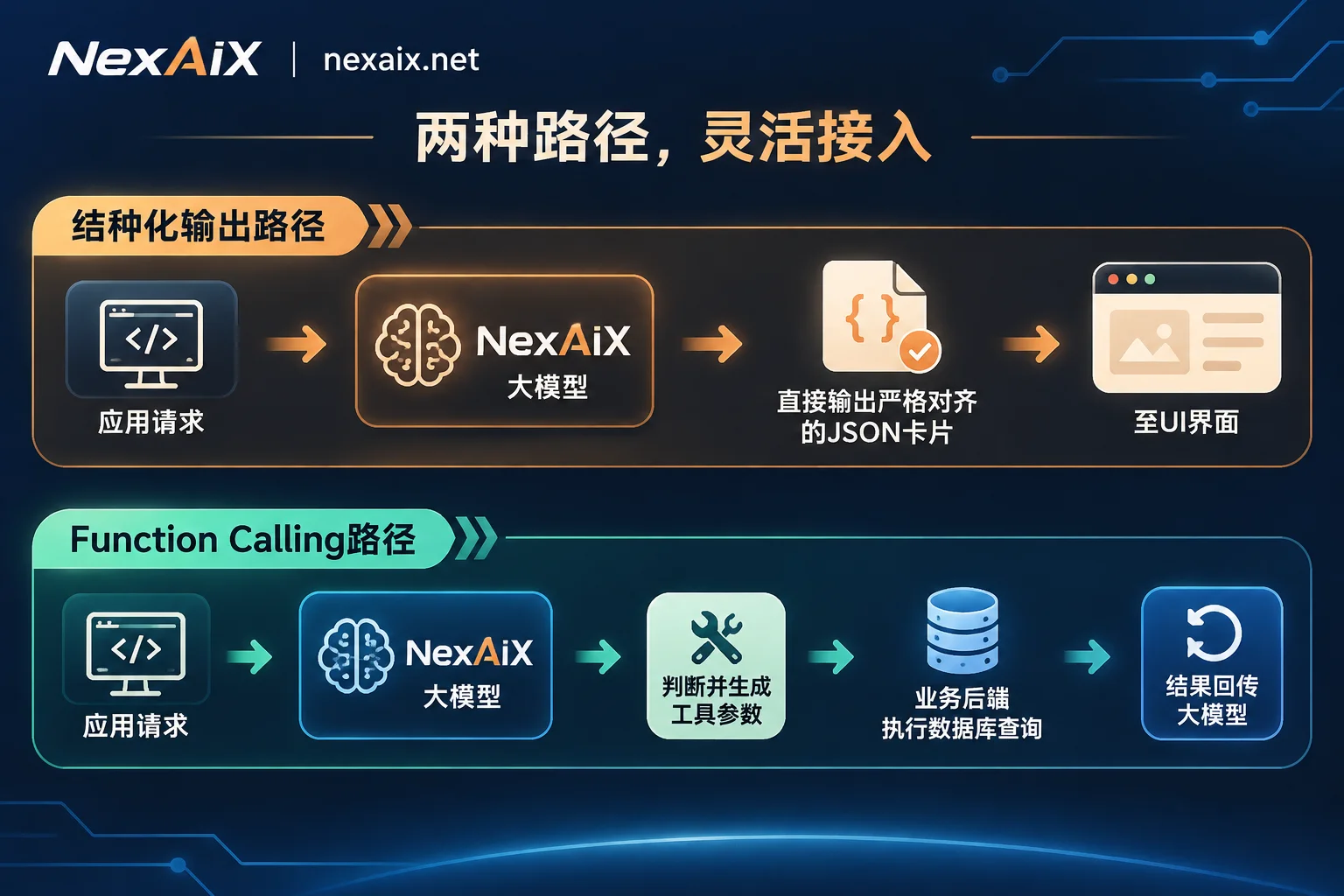
In real composite business flows (for example, "first query the database to verify order status, then return to the frontend in a fixed card format"), the most robust approach is staged processing: the first hop completes interaction with the business backend through standard tool calling, and the second hop injects the tool-returned data into the context and asks the model to generate the final structured response.
2. Why Do Your GPT API Structured Calls Always Fail in Production?
Having clarified the contract design at the code level, why do JSON parsers and tool-calling chains in online environments still fail frequently? Besides overly complex business Schemas (such as excessively deep nesting or abuse of optional fields), a large part of the root cause lies in the quality of the underlying API supply and the completeness of parameter passthrough.
To reduce call costs or solve network connectivity issues, many teams use non-standard reverse-engineered interfaces or shared account pools. This triggers four typical "gray rhino" failures in structured call scenarios:
1. tools Field Silently Lost Due to Reverse-Engineered Web Protocols
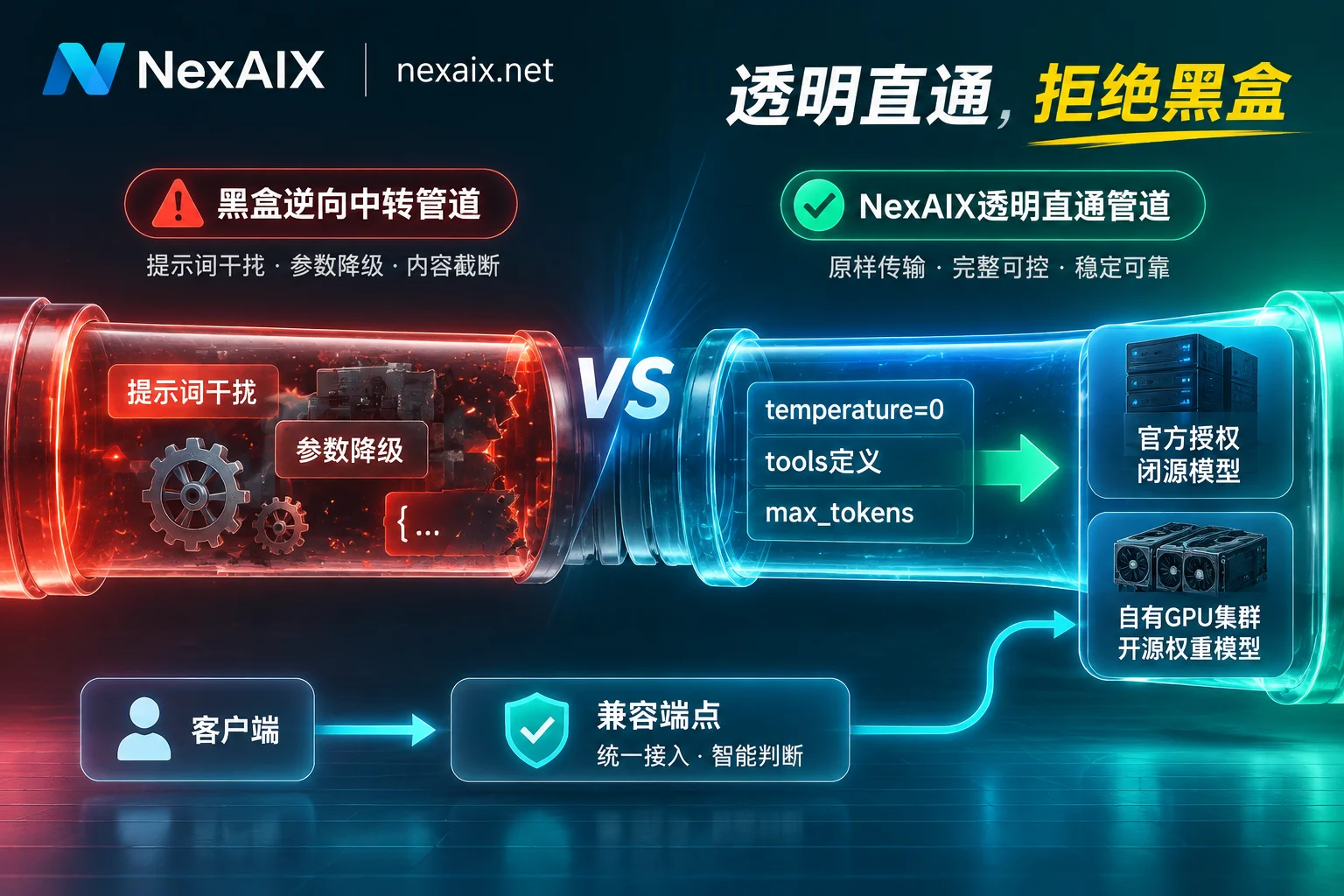
The standard OpenAI Chat Completions interface has strict protocol parsing for tools and tool_choice at the underlying level. Some low-cost relay stations on the market instead use a "reverse-engineered web client protocol (Web-to-API)" approach: after receiving a developer's API request, they forcibly concatenate your tools JSON Schema into a natural language passage and stuff it into the conversation, then after the model outputs text, use regular expressions to hard-extract function names and parameters.
This approach may get by in simple scenarios, but once there are concurrent multi-tool calls or complex parameters containing escape characters, regex matching instantly fails, causing frequent JSONDecodeError exceptions online. (For how to identify reverse relay and account pool risks, see 2026 AI API Relay Selection and Pitfall Guide.)
2. Schema Contamination Caused by Injected Hidden System Prompts
To make the model strictly output pure JSON or precisely trigger tools, developers usually fine-tune the System Prompt and sampling parameters (such as lowering temperature to 0 or close to 0). However, some opaque proxy channels privately inject hidden system prompts at the forwarding layer (for example, forcing additional short-answer instructions or third-party identity statements), or even lock the sampling temperature. This external interference directly breaks the model's instruction-following boundary, causing the model to sandwich greeting text before and after JSON code blocks and directly defeating downstream business code that strictly relies on JSON.parse().
3. Implicit Model Downgrades and Low-Precision Quantization
Multi-step tool calling and complex Schema constraints are extremely sensitive to the model's logical reasoning capability. If the upstream provider secretly replaces your requested flagship model with a lightweight small model during peak traffic, or blindly uses overly lossy extreme quantization precision in open-source model inference, the model's instruction-following ability collapses—manifesting as frequently fabricating nonexistent tool names, omitting required parameters, or filling illegal values into enum fields. (For how to troubleshoot such issues through engineering means, see Don't Let "Black-Box" APIs Slow Down Agent Development: Building an Auditable, Non-Downgraded Production-Grade Agent Foundation.)
4. max_tokens Secretly Truncated, Causing JSON Closure Failures
When the business requires the model to batch-extract structured entity lists from long documents, the output JSON string is often thousands of tokens long. If the gateway layer privately lowers the maximum output limit (max_tokens) to save compute, the generated JSON stops abruptly midway (missing closing } or ]). If the client code does not first check whether finish_reason in the response body is length, but instead feeds it directly into a deserializer, it triggers hard-to-troubleshoot parsing exceptions. (For a systematic fix for truncation issues, we recommend reading What to Do When Large Model API Output Is Truncated: Check finish_reason First, Then Fix by Cause.)
3. Architecture Evolution: Hybrid Structured Scheduling Based on GPT-5.6 and gpt-oss
In the 2026 model ecosystem, binding all structured tasks to a single top-tier closed-source model is neither economical nor immune to a single upstream's quota bottlenecks. Smart technical teams are building a hybrid calling architecture of "closed-source flagship + open-source weights":
- Core complex routing and high-difficulty reasoning (closed-source authorized channels): For scenarios that require orchestrating a dozen external tools, maintaining complex state machines across multi-turn conversations, or financial and security review with extremely low fault tolerance, call GPT-5.6 directly (or peers from the Claude, Gemini, and Grok series). These models have significant advantages in complex intent decomposition and boundary control.
- High-frequency data extraction and lightweight tool calling (own compute with open-source weights): OpenAI's open-weight series gpt-oss (such as
gpt-oss-120bandgpt-oss-20b, under the Apache 2.0 license) was deeply optimized during training for chain-of-thought reasoning, instruction following, and few-shot function calling. In high-frequency scenarios such as daily log structured cleaning, fixed-Schema form conversion, or single-step tool routing, usinggpt-ossor open-weight models such as DeepSeek, Qwen, GLM, Kimi, and MiniMax can greatly amortize per-task cost. (For more migration details on this architecture, see How to Cope with the GPT API Model Retirement Wave: From Legacy Migration and Compliance Pitfalls to Hybrid Calling of GPT-5.6 and gpt-oss.)
For this hybrid architecture to run smoothly at the code level, the prerequisite is an API foundation that strictly follows the OpenAI Chat Completions specification, uses a unified endpoint, and never interferes with verbatim parameters.
4. Engineering in Practice: Zero-Modification Onboarding and Verbatim Verification on NexAIX
As a production-grade AI API platform for R&D teams, NexAIX directly eliminates all kinds of hidden pitfalls in structured calling at the levels of underlying supply and protocol implementation:
- Transparent dual-track supply system:
In the NexAIX Model Hub, the supply method of every model is clearly labeled. Closed-source models such as GPT-5.6 all go through official commercial license channels from vendors, with contracts and auditability, and never use shared account pools or reverse-engineered web protocols; open-weight models such as gpt-oss, DeepSeek, and Qwen use own compute deployment, running on self-built and leased GPU clusters, with context window, maximum output, and inference precision (such as BF16, FP8, MXFP4, etc.) clearly published on the model detail page. You can check the Supply Transparency and Self-Verification Guide at any time to understand the strict boundary between the two. - 100% verbatim passthrough and no-downgrade commitment:
NexAIX strictly implements streaming output, function/tool calling, and multi-turn conversations according to the OpenAI Chat Completions specification. Thetemperature,top_p, andmax_tokensin requests are passed through verbatim; no hidden system prompts are injected, context and maximum output are not truncated, and small models are not secretly swapped in the background nor inference precision lowered. Themodelfield in the response body is the actually executed model, and developers can verify at any time using four methods such as fixed Prompt with random seed re-tests and maximum-length stress tests (see No-Downgrade Commitment and Self-Verification Methods). - Clear 429 rate-limit signal, refusing fake hangs and unauthorized flow switching:
In automated workflows, the biggest fear is the gateway hanging connections indefinitely when saturated, or taking it upon itself to silently route requests to a weaker backup model (which directly causes Function Calling that strictly relies on specific model capabilities to fail). NexAIX insists on deterministic responses from a single endpoint: when encountering upstream quota or cluster concurrency saturation, it directly returns the standard HTTP429status code with aRetry-Afterresponse header, returning full control of backoff retries or switching to an alternative model to your business code (see High Throughput and Rate-Limiting Mechanism).
Code Example: Seamlessly Switch Tool Calling Between GPT-5.6 and gpt-oss with One Key
If your project already uses the official OpenAI SDK (or LangChain, LlamaIndex, Vercel AI SDK, Dify, or any framework that supports custom base_url), migrating to NexAIX only requires changing two lines of configuration: point base_url to https://api.nexaix.net/v1 and replace it with your NexAIX API Key.
The following demonstrates how to seamlessly switch between closed-source and open-source models in the same standard Function Calling code by only changing the model field (note: for the exact model IDs actually called and the three-step integration code, please refer to the individual model page on the official website; when visiting the model page URL, replace the dots in the model ID with hyphens):
from openai import OpenAI
import json

# 仅需替换 base_url 与 api_key,其余业务代码零改动
client = OpenAI(
    base_url="https://api.nexaix.net/v1",
    api_key="sk-nexaix-your-api-key"
)

# 定义标准的工具契约 (Function Calling Schema)
tools = [
    {
        "type": "function",
        "function": {
            "name": "query_order_status",
            "description": "根据订单号查询当前物流与履约状态",
            "parameters": {
                "type": "object",
                "properties": {
                    "order_id": {
                        "type": "string",
                        "description": "格式如 ORD-20261107-XXXX 的标准订单编号"
                    },
                    "include_history": {
                        "type": "boolean",
                        "description": "是否返回完整的物流节点历史"
                    }
                },
                "required": ["order_id", "include_history"],
                "additionalProperties": False
            }
        }
    }
]

def run_agent_step(user_query: str, target_model: str):
    response = client.chat.completions.create(
        model=target_model,  # 切模型只改这一个字段,如切换 GPT-5.6 或 gpt-oss 系列
        messages=[
            {"role": "system", "content": "你是一个严谨的订单处理助手,需要查询数据时请精准调用工具。"},
            {"role": "user", "content": user_query}
        ],
        tools=tools,
        tool_choice="auto",
        temperature=0.0  # 原样透传,确保结构化参数生成的确定性
    )

    # 核对实际执行的模型与结束原因
    choice = response.choices[0]
    print(f"[Audit] 实际执行模型: {response.model} | 结束原因: {choice.finish_reason}")

    if choice.finish_reason == "tool_calls" and choice.message.tool_calls:
        for tool_call in choice.message.tool_calls:
            func_name = tool_call.function.name
            # 严格校验并解析 JSON 参数
            func_args = json.loads(tool_call.function.arguments)
            print(f"触发工具: {func_name} | 解析参数: {func_args}")
            return func_name, func_args
    return None, choice.message.content
When maintaining the above calls in production, you can also harden your system defenses with the following engineering measures:
- Data privacy and compliance auditing: Tool-calling parameters often contain sensitive internal business fields (such as order numbers and customer identifiers). On the NexAIX platform side, all Prompts and Completions flow only in memory and are released as soon as the request ends—never written to disk, never logged as conversations, and never used for any model training; all transmission uses TLS 1.3 encryption. Each call also returns a unique request ID, making it easy for technical teams to troubleshoot efficiently while retaining only metadata (see Zero-Logging and Per-Key Isolation Mechanism).
- Per-Key isolation of permissions and billing: It is recommended to allocate a separate API Key for each microservice or Agent node. Each Key has independent concurrency quotas and separate itemized billing by model; if a business node's key is accidentally leaked, it can be revoked separately at any time without affecting global business.
5. Conclusion
As large model APIs penetrate the capillaries of enterprise software, engineering teams no longer compete on who can write fancier prompts, but on who can build a calling architecture with tight contracts, controllable latency, and fully transparent underlying supply. Clarify the engineering boundary between Function Calling and Structured Outputs, and say goodbye to reverse proxies full of black-box operations, so your business code can completely escape fragile regex patches and occasional crashes.
If you are selecting a GPT API for a new project, or want to smoothly migrate your existing OpenAI SDK, LangChain, or Dify workflows to more stable infrastructure that supports hybrid scheduling of closed-source and open-source weights, you are welcome to visit the NexAIX Console and register with your email—no cumbersome enterprise qualification review is required, and test credits are granted upon registration. Technical teams with needs for custom high-concurrency quotas, enterprise contracts and invoices, data processing agreements (DPA), or compute evaluation of open-source models outside the list are also welcome to contact our engineering team directly at [email protected].