 NexAIX-官方博客
First, the conclusion: AI API prices cannot be compared directly based on listed prices. You must unify the four dimensions—input tier (cache hit/miss), output tier, service tier, and capability tier—and then convert to a weighted unit price based on your actual request distribution for meaningful comparison. On July 30, 2026, OpenAI adjusted GPT-5.6 tiered pricing, and on July 31, DeepSeek-V4-Flash-0731 launched. Both events reset the baseline for price comparison, making them ideal references for magnitude.
Dimension 1: Input tokens must be split into cache hit and miss tiers
For the same model, input pricing often has two tiers: "cache hit" and "miss". If you only look at the listed input price, you may overestimate costs. For example, DeepSeek-V4-Flash-0731, as officially published on July 31, 2026: input $0.14/1M tokens, cache hit as low as $0.0028/1M, a 50x difference. If your system prompts or few-shot samples have high reuse, your actual input cost will be significantly diluted.
How to estimate hit ratio? The most direct way is to count the prompt repetition rate over a week: divide the number of requests with identical prefixes by total requests to get an approximate hit rate. Multi-turn conversations with stable prefixes usually have higher hit rates, while RAG scenarios with new retrieval snippets each time are significantly lower—use your own logs for the specific ratio, don't apply experience values. You can plug the repeated prefix ratio calculated from your logs into the formula.
Dimension 2: Output token price is several times input—often the most underestimated AI API cost
Output unit price is typically several to dozens of times the input, amplifying the bill far more than input. For example, GPT-5.6 Luna, after the July 30, 2026 adjustment, input $0.20/1M and output $1.20/1M—output is 6x input. DeepSeek-V4-Flash-0731 output is $0.28/1M, exactly 2x the input $0.14. If your application is long-answer, code generation, or reasoning-based, output length directly determines total cost.
So before comparing, always calculate the P50 and P90 of output tokens from your logs. If P90 is much higher than P50, there is a long-tail distribution of outputs; such requests inflate the bill, and you should amplify output weight when selecting models. Reasonable practice is to estimate output distributions for different business lines separately, rather than masking differences with site-wide averages.
Dimension 3: Does the service tier count into the base unit price? (How to verify Fast mode / service_tier)
The most easily overlooked layer in AI API price comparison is the service tier. On July 30, 2026, OpenAI renamed Priority processing to Fast mode and supports calling via the service_tier: 'fast' field. This means the service tier is an independent third variable from the model tier. When comparing, you must confirm which tier your actual requests use. Verify in three steps: ① Check whether your request body explicitly passes the service_tier field and its value; ② Look at your bill or usage export for separate usage lines for different tiers, e.g., fast and standard listed separately; ③ After switching tiers, closely observe changes in P95 latency and per-request cost to confirm whether the improvement meets business needs. But note, Fast mode is not a standard field across all providers; whether it adds cost and how it is billed must be verified on each provider's pricing page. Ignoring this layer may lead you to compare base prices with others' priority processing prices, distorting the conclusion.
Dimension 4: How wide can the capability tier gap be within a family? (Magnitude based on July 2026 prices)
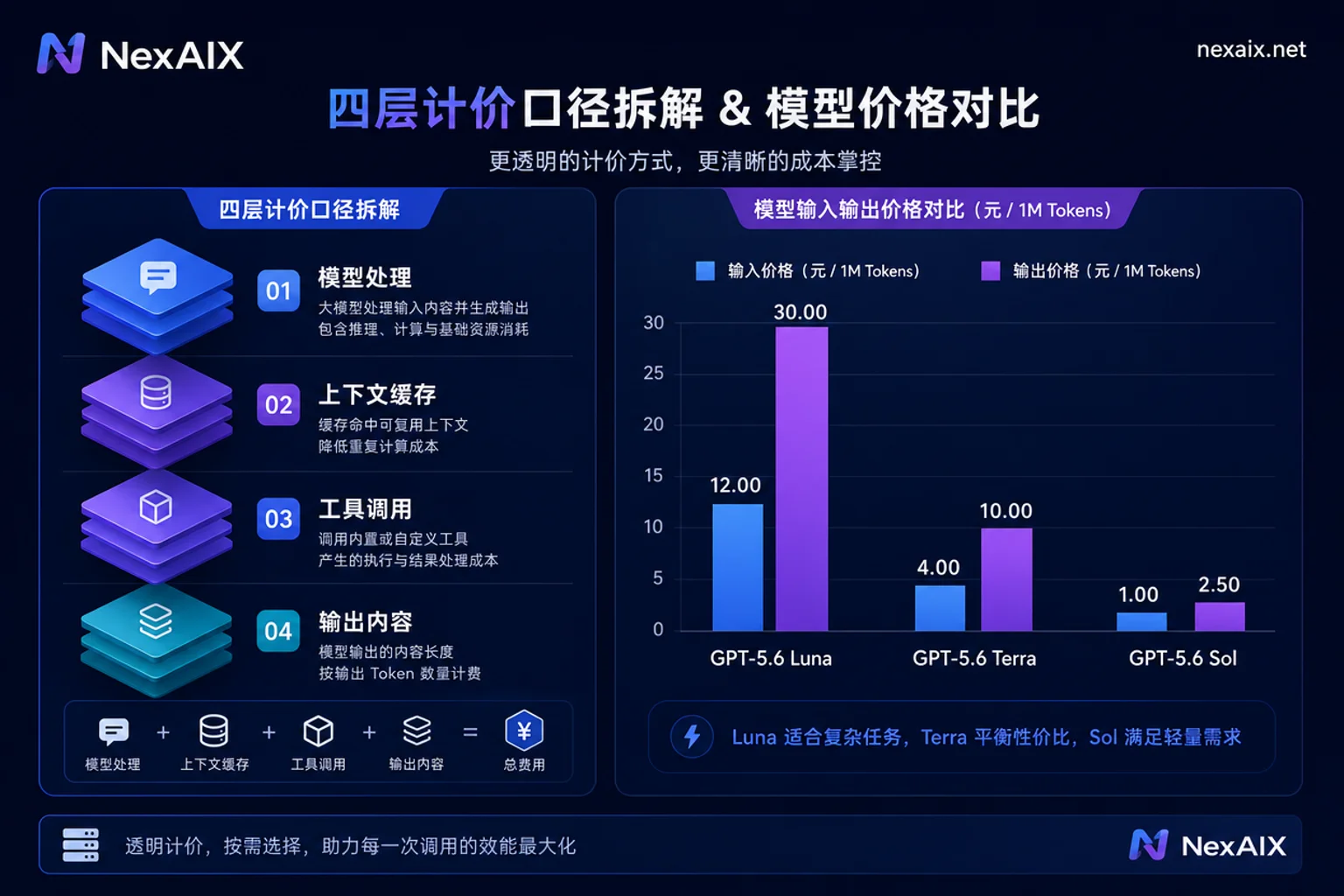
Capability tier price differences within the same family can be enormous. As an example, using OpenAI official prices as of July 30, 2026 (per million tokens):
| Model Tier | Input Price ($) | Output Price ($) | Multiple vs. Lowest Tier |
|---|---|---|---|
| GPT-5.6 Luna | 0.20 | 1.20 | 1x |
| GPT-5.6 Terra | 2.00 | 12.00 | 10x |
| GPT-5.6 Sol | 5.00 | 30.00 | 25x |
After Luna's 80% price cut, the gap between the lowest and flagship tier has widened to about 25x. This means the choice of capability tier directly determines the cost magnitude, and the savings from downgrading can be significant. But note, these are public prices at a specific point in time; always refer to the official pricing page for current data.
Convert the four dimensions into a single weighted unit price formula
After unifying the four dimensions, AI API prices can be converted into a comparable weighted unit price formula:
加权单价 =
 (命中率 × 缓存命中输入价 + 未命中率 × 标准输入价) × 输入token占比
 + 输出价 × 输出token占比
 + 服务档位加价(如有)
Example: Suppose a business has 60% input, 40% output, and a hit rate of 70%. Using DeepSeek-V4-Flash-0731, with input $0.14, cache hit $0.0028, output $0.28, the weighted unit price ≈ (0.7×0.0028+0.3×0.14)×0.6+0.28×0.4≈0.026+0.112=0.138 USD per million tokens. If output accounts for 80%, the weighted unit price rises to about 0.23 USD—a significant difference.
Note: Different business lines should be calculated separately, not averaged site-wide. For example, customer service bots have short outputs, while code generation has long outputs; their optimal choices may be completely different. Splitting by business line gives a handle for AI API cost optimization; site-wide averages mask the true cost of long-output businesses.
Downgrade decisions: which tasks can be downgraded, which must stay on the flagship tier
Before downgrading, assess the task nature: lightweight tasks like classification, extraction, rewriting, and routing are often well-served by lower-tier models and can be safely downgraded; but complex agent orchestration, long-chain reasoning, and code modification tasks may lead to retries and errors if capability is insufficient, incurring higher hidden costs—proceed with caution.
However, a lower price tier does not necessarily mean weaker. DeepSeek-V4-Flash-0731, through re-Post-training, surpasses the V4-Pro preview on Coding Agent benchmarks like Terminal Bench 2.1, while maintaining input $0.14/output $0.28. This reminds us that capability tier and price are not strictly positively correlated; you must test by task.
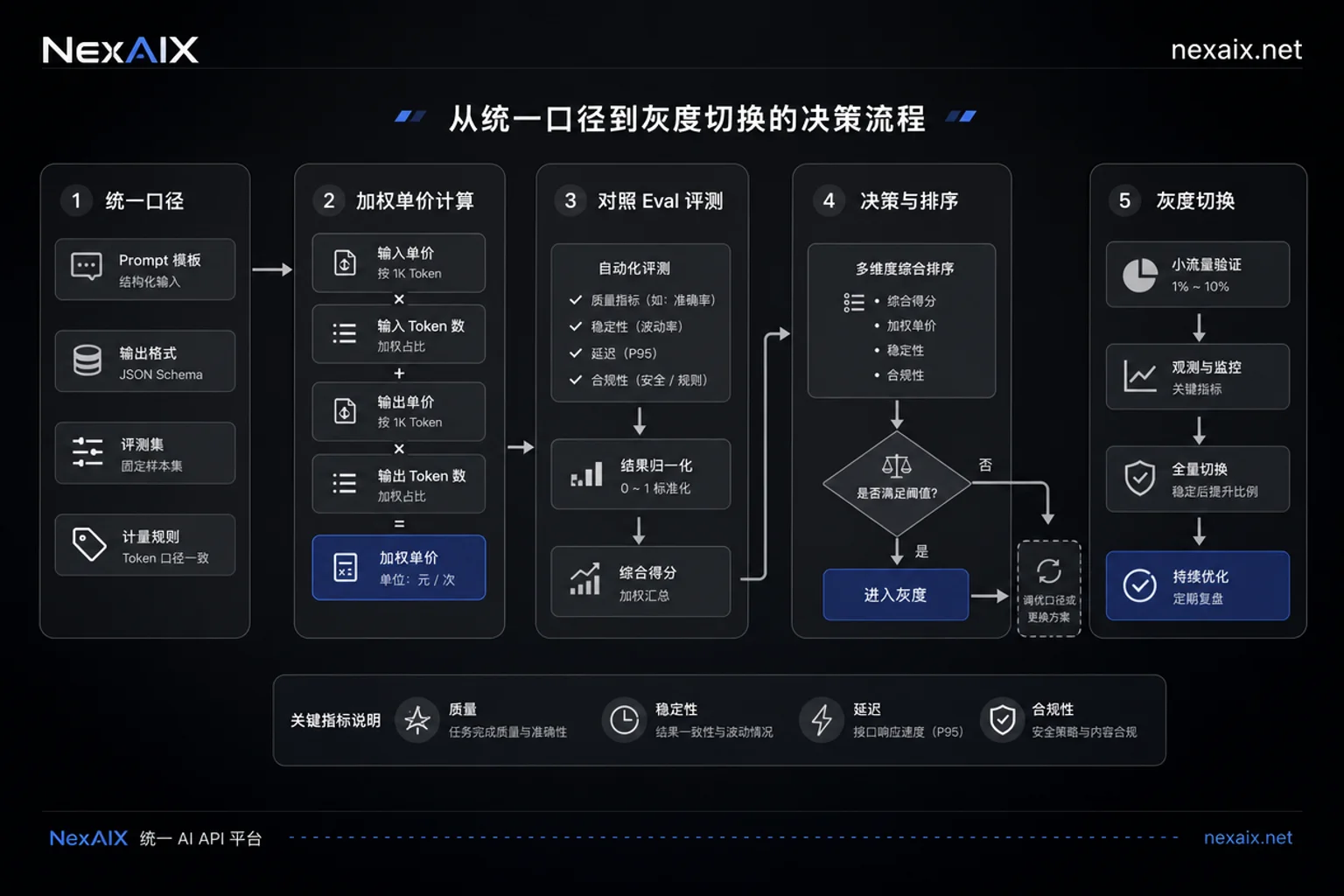
Mandatory comparative eval before downgrading: Run the same evaluation set with the same code, only changing the model
To determine whether a downgrade is feasible, the most reliable method is to run a controlled experiment: fix the evaluation set and sampling parameters, only change the model field, and record accuracy, retry rate, and output length. Then incorporate the extra cost from retries and overly long outputs back into the unit price. If higher retry rates push the final cost above the flagship tier, the downgrade is not worth it.
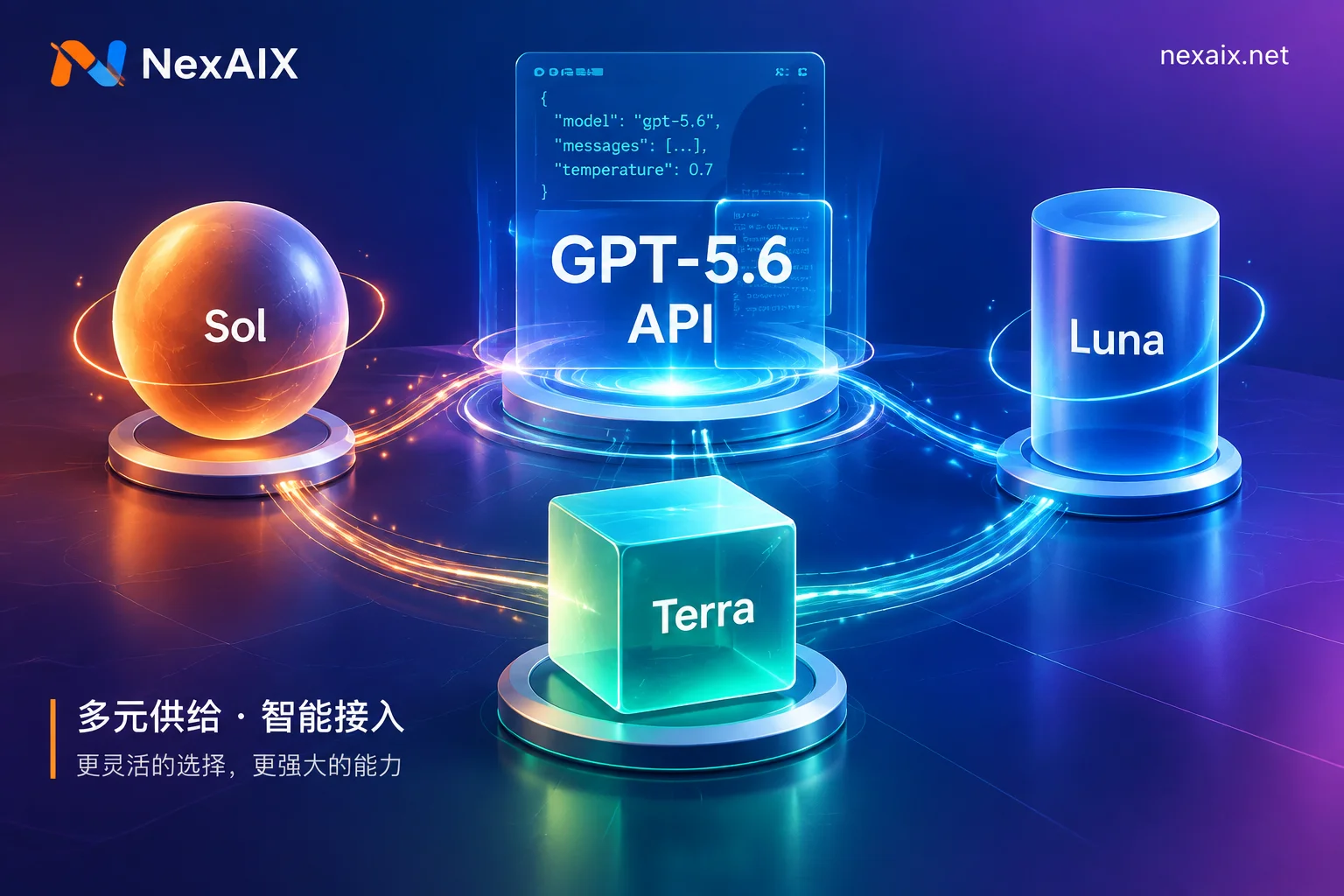
A prerequisite for horizontal price comparison is that the same code can switch models seamlessly. NexAIX provides an OpenAI Chat Completions compatible API with base_url https://api.nexaix.net/v1,返回体的model字段对应实际执行模型,且满载时按标准429处理而非静默降级,这让成本核算更可信。你可以用它在GPT-5.6, allowing you to run the same evaluation set across Terra/Sol and DeepSeek V4 Flash/Pro to compare weighted unit price and effectiveness. For specific pricing, specs, and availability, refer to NexAIX's current model page and pricing page.
AI API procurement checklist: 8 billing details to clarify
- Is the billing unit consistently per million tokens, and is the tokenizer algorithm the same?
- Definition and retention duration of cache hit price (does it expire?)
- Does the output price include reasoning tokens (e.g., chain-of-thought)?
- Does the service tier (e.g., fast) incur an additional charge?
- Does the request's model field correspond to the actual executed model?
- Do rate limits and 429 retries affect effective cost? (See strategies for AI API 429)
- Do billing granularity and usage export support splitting by business line?
- Is there a notification mechanism for price changes to avoid billing surprises?
Additionally, be aware of AI relay station water injection and ensure the model field returned by the provider is trustworthy.
FAQ
How to calculate AI API price?
First, unify the four dimensions: input cache hit/miss, output, service tier, and capability tier. Then convert to a weighted unit price based on actual request distribution, using the formula above. Only after unifying the dimensions are AI API prices comparable.
How much does a large model API cost per million tokens?
In July 2026, DeepSeek-V4-Flash-0731 official input $0.14, output $0.28; GPT-5.6 Luna input $0.20, output $1.20 (all per million tokens). Prices vary greatly by model and depend on cache and service tier; it's recommended to calculate based on actual usage. These are public prices as of July 30-31, 2026; refer to the official pricing pages for current data.
How much more expensive are output tokens compared to input tokens?
Outputs are typically 2-6 times inputs. For example, DeepSeek output is 2x input, GPT-5.6 Luna is 6x, and flagship Sol is 6x. For long-output scenarios, focus on output costs.
How much more expensive is GPT-5.6 Terra compared to Luna?
Luna input $0.20/output $1.20, Terra input $2.00/output $12.00—Terra is 10x the price of Luna. The gap has widened to 10x, making the economics of downgrading lightweight tasks like classification and extraction more attractive, but test by task. These are public prices as of July 30-31, 2026; refer to the official pricing pages for current data.
Will downgrading AI API affect performance?
Possibly, but it depends on the task. Simple tasks like classification and extraction have minimal impact; complex reasoning or code generation may degrade significantly. You must validate with comparative evals, not just look at price.
Does the service_tier fast mode incur an extra fee?
OpenAI renamed Priority processing to Fast mode. Whether it adds a surcharge was not clearly stated in the announcement; you need to check the pricing details of OpenAI-compatible API providers. Policies vary among providers, and relay or aggregation platforms with OpenAI-compatible APIs may or may not pass through this field. Confirm with each provider when comparing.


Comments(0)