 NexAIX-官方博客
Although major model providers continue to lower their per-million-token prices, many technical teams still face "bill shock" when reconciling accounts at the end of the month. As businesses shift from single-turn conversations to multi-step reasoning AI Agents and automated coding workflows, tokens have evolved from a mere technical parameter into a business metric that directly affects project ROI.
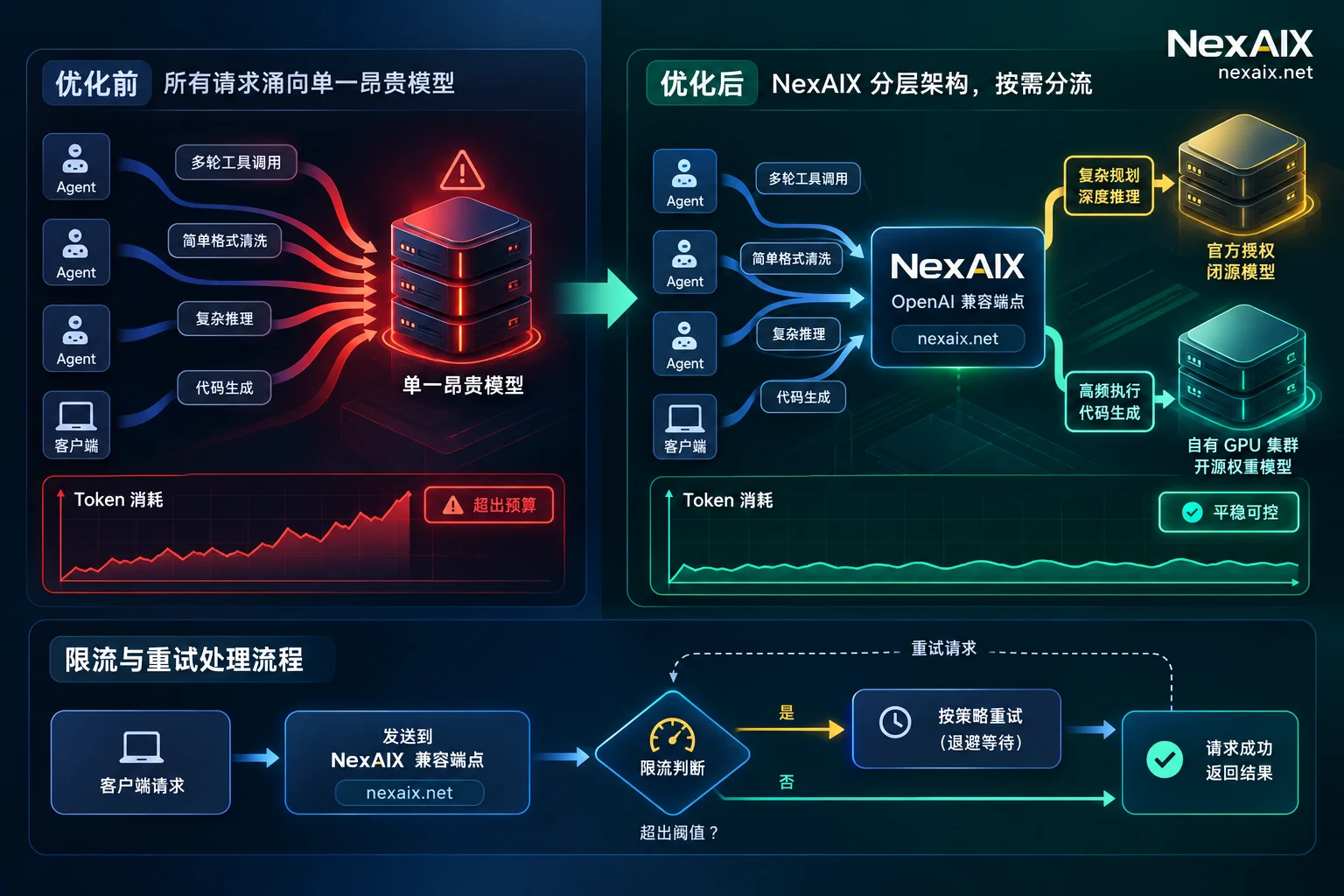
In production environments, a complex Agent task often involves reading files, calling tools, parsing error messages, and multiple rounds of self-correction. It is now common for a single task to trigger 50 to over 100 consecutive API calls, with token consumption 10 to 100 times that of traditional chat scenarios. More troublesome is that many teams find their bills out of control not because of a surge in business volume, but due to architectural issues: "indiscriminate use of flagship models for all tasks," repeated retries caused by covert downgrades in low-price channels, or leakage and infinite loops of an API key hosted in a third-party tool.
True AI API cost optimization is by no means about finding cheap, dubious reverse-engineered endpoints. Instead, it is about building an engineering system that features "on-demand model tiering, controllable per-call loss, genuine non-downgraded channels, and clear billing aggregation by key." This article will break down how to make AI bills clear and controllable without sacrificing business delivery quality, from four production-grade practical dimensions.
1. Why Are Total Bills Out of Control Despite Falling Token Prices?
Before changing code, technical leaders need to identify the four common black holes that devour budgets:
- Compute mismatch (using a sledgehammer to crack a nut): In automated workflows, lightweight subtasks such as intent recognition, JSON format cleaning, and log extraction account for over 70% of total calls, yet they share the same high-cost closed-source flagship model used for core architecture design and complex code refactoring.
- Context snowballing: Each time the Agent executes a tool call, it stuffs the complete history and lengthy raw tool returns (such as a full HTML page or an untrimmed error stack) back into the next request unchanged. Note that ultra-long inputs not only multiply input token billing but also significantly increase time to first token (TTFT) and overall call costs.
- Retry storms and hidden losses: To save money, some teams use unofficial "low-price relays," only to find that the upstream secretly swaps the model for a smaller one, downgrades quantization, or truncates context, causing frequent parsing failures of structured outputs. The automatic retry mechanism on the business side is triggered, turning a task that could succeed in one call into five invalid calls, doubling the overall cost.
- Loose key management and sudden leaks: Multiple projects and developers' local IDE plugins (such as various AI coding assistants) share the same master key. Once an external tool has a security leak or a test script falls into an infinite loop, a key without independent quota limits can generate high bills within hours.
2. Architecture-Level Cost Reduction: Tiered Combination of Closed-Source Flagships and Open-Source Models on Own Compute
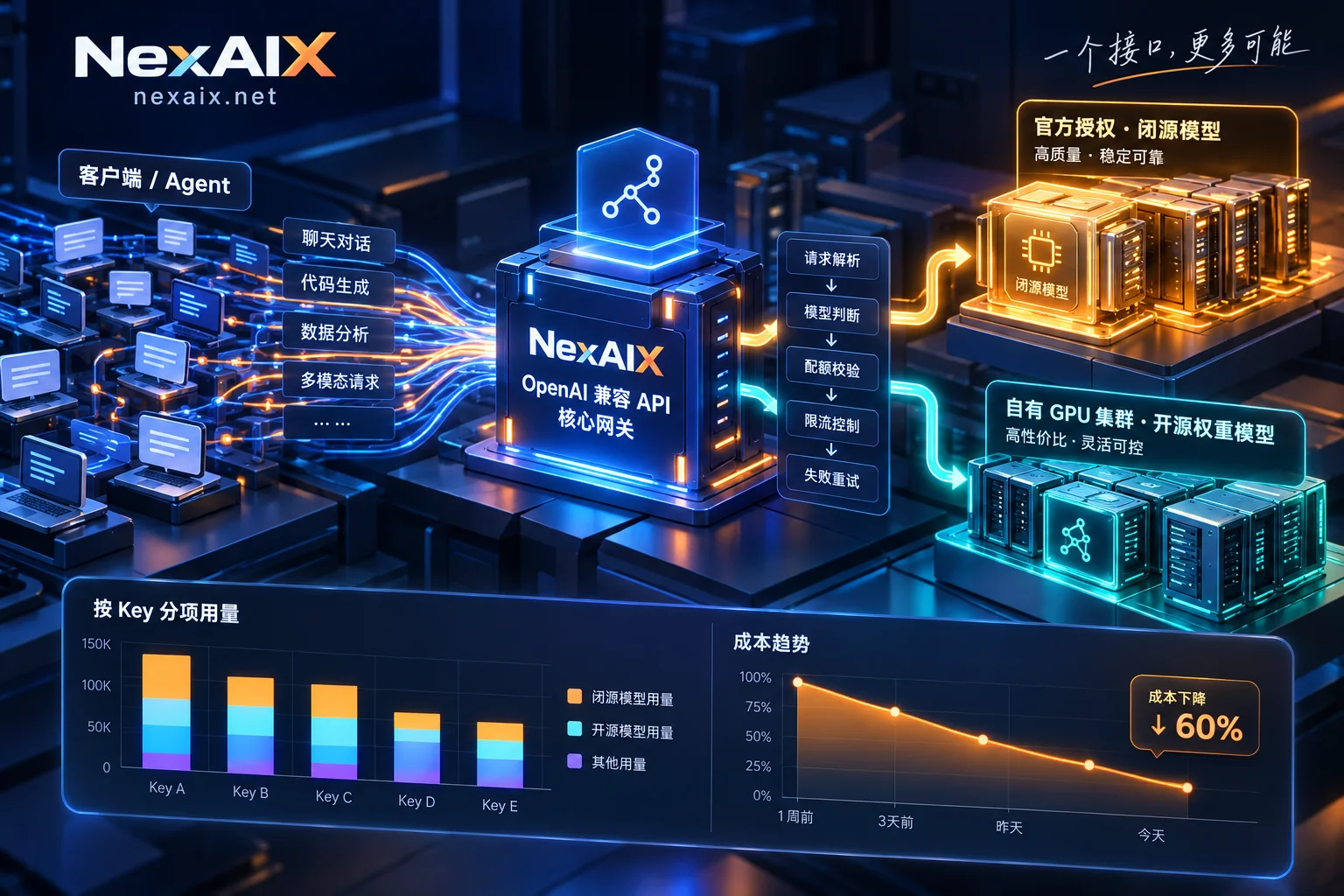
The most direct lever to reduce per-task cost is to break down the workflow and let models of different tiers play their respective roles: use top closed-source models as the "brain" for complex planning and fallback, and use cost-effective open-source weight models as the "limbs" to execute high-frequency subtasks.
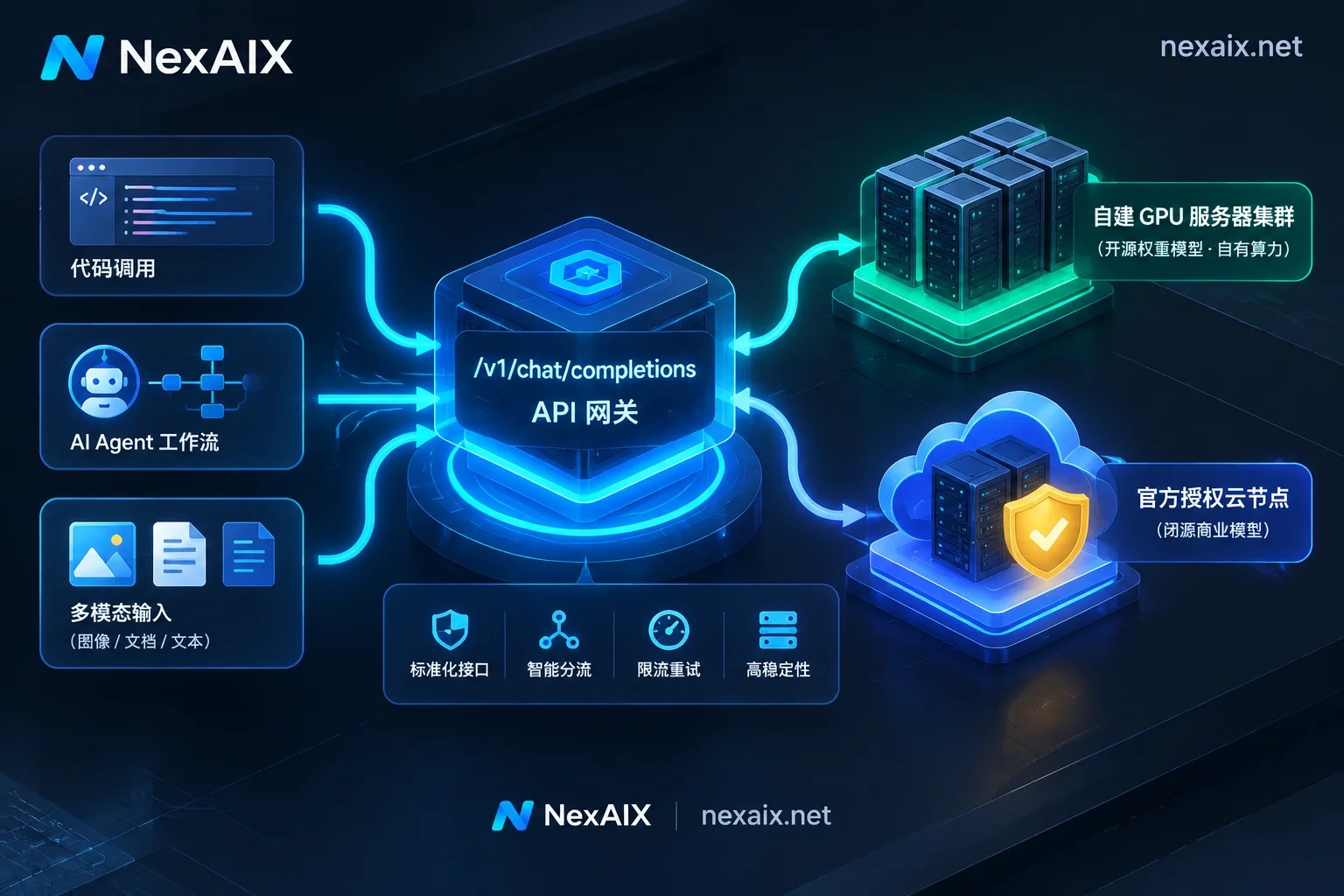
In the past, such a hybrid architecture meant teams had to integrate SDKs from five or six providers, maintain multiple authentication logics, and handle different interface parameters. However, with NexAIX's OpenAI-compatible endpoint, developers only need to change the project's base_url to https://api.nexaix.net/v1, and with a single key, they can call all activated closed-source and open-source models in a completely consistent interface format.
1. Two Types of Deterministic Supply, Precisely Matched by Scenario
In the NexAIX Model Plaza, all models clearly indicate the supply method, context window, maximum output, and inference precision, making it easy for teams to tier selections based on cost and capability:
- Core planning and high-difficulty reasoning (closed-source models via official authorized channels): For complex system architecture, multimodal deep understanding, or high-difficulty decision-making, you can directly call models such as
Claude,GPT-5.6,Grok, andGemini. NexAIX's closed-source models all come through official commercial licenses from vendors, with contracts, invoices, and auditability. We never use account pools or reverse-engineered client protocols. - High-frequency execution and daily coding (open-source weight models deployed on own compute): For code completion, document summarization, data cleaning, RAG retrieval re-ranking, and other stages that account for the vast majority of calls, you can switch to
DeepSeek,Kimi,GLM,MiniMax,Qwen, orgpt-ossseries. These open-source weight models are deployed by NexAIX on its own GPU clusters in self-built and leased data centers, operated and maintained by ourselves, without reselling third-party quotas. The model pages transparently indicate inference precisions such asBF16,FP8, andMXFP4(for the impact of precision on performance and cost, see "What's the Difference Between Model Inference Precisions BF16 and FP8: VRAM, Speed, Quality, and Selection").
2. Code-Level Seamless Switching and Explicit Degradation Control
Since open-source and closed-source models share the same OpenAI Chat Completions specification (including streaming output, function/tool calls, and multi-turn conversations), model tiering in code only requires changing the model field. If your existing application is migrating from another platform, for specific modification details, see "What Code Changes Are Needed When Switching Large Model APIs: Three Must-Change Configurations and Four Types of Parameter Compatibility Checks".
In production, we recommend that business code retain control over routing and fallback decisions. NexAIX adheres to the principle of a single supplier and a single endpoint. When encountering a sudden traffic surge, the system returns a standard HTTP 429 status code with a Retry-After response header, and will never silently forward your request to a cheaper model in the background. Developers can write controllable tiering and fallback logic at the business layer based on explicit status codes:
from openai import OpenAI, RateLimitError
import time

client = OpenAI(
    base_url="https://api.nexaix.net/v1",
    api_key="YOUR_NEXAIX_API_KEY"
)

def run_agent_step(task_type: str, messages: list, max_output: int = 1024):
    # 根据任务复杂度显式分层:复杂规划用闭源旗舰,高频子任务用自有算力开源模型
    # 具体模型 ID 请以 https://nexaix.net/models/ 实时列表为准
    target_model = "gpt-5.6" if task_type == "complex_planning" else "glm-5.2"

    try:
        response = client.chat.completions.create(
            model=target_model,
            messages=messages,
            max_tokens=max_output,
            temperature=0.2
        )
        # 核对返回体中的实际执行模型,确保账单与预期一致
        assert response.model == target_model
        return response.choices[0].message.content

    except RateLimitError as e:
        # 收到标准 429 时的显式处理策略:读取 Retry-After 退避,或由业务主动切备用模型
        print(f"触发配额限流,准备退避或切换模型: {e}")
        time.sleep(2)
        # 业务方自主决定是否切换至同档位其他开源权重模型(如 deepseek 或 kimi 系列)
raiseTip: When checking individual model specifications and integration code, replace dots in the model ID with hyphens in the model page URL slug (for example, visithttps://nexaix.net/models/glm-5-2/to view specifications), while in the API request body, themodelfield should still useglm-5.2. If your team needs open-source weight models not listed, send the model name and estimated usage to[email protected], and we will evaluate compute and reply with a schedule.
3. Payload-Level Cost Reduction: Controlling Long-Context Bloat and Output Truncation Losses
After selecting the right models, the next step is to wring out the "water" in each request.
- Control input history length and avoid meaningless full resends: When building multi-turn conversations or Agent loops, do not blindly append all historical messages to the
messagesarray. As mentioned earlier, ultra-long inputs cause time to first token and per-call costs to rise with input length. For history, we recommend keeping only the most recent N full interactions, compressing earlier context into concise summaries using lightweight open-source models; for ultra-long JSON or web page source code returned by tool calls, filter fields locally in code before feeding them to the model. (Further reading: "Model Context Window Comparison: How to Calculate Window and Output Limits, and How to Avoid Truncation, Latency, and Rate Limiting") - Set
max_tokensproperly to prevent full reruns caused by truncation: Many developers either leavemax_tokensunset, letting the model ramble and consume expensive output tokens, or set it too small, causing JSON output to be truncated midway (finish_reason: length), resulting in parsing errors and invalidating the entire request for a rerun. Before integration, be sure to check the target model's "context window" and "maximum output" limits on the NexAIX model page, and use a concise System Prompt to instruct the model to output structured results directly. (For troubleshooting truncation issues, see "What to Do When Large Model API Output Is Truncated: First Check finish_reason, Then Fix Item by Item")
4. Avoiding the "Fake Low Price" Trap: Why Covert Downgrades Double Total Costs
When researching AI API cost optimization solutions, many teams are easily attracted to relay stations advertising "10% of official price." However, in actual production, such channels, which rely on assembling personal account pools or reverse-engineering web protocols, are often the main culprits behind soaring overall R&D costs.
To maintain profits at extremely low prices, unscrupulous channels often use four covert tactics:
- Dynamically swapping requests for expensive models with cheap small models;
- Privately downgrading official
BF16/FP8weights to extremely low-bit quantized versions; - Secretly truncating long contexts or limiting maximum output length at the gateway layer;
- Injecting hidden system prompts to make the model "answer briefly," undermining the business's original instruction-following capabilities.
Once subjected to these dark operations, your Agent's tool-calling accuracy and code generation first-pass success rate will plummet. An automated pipeline that previously succeeded in one call will trigger hundreds or thousands of retries due to format errors and logical hallucinations, and engineers may even spend many hours investigating "why did a prompt that worked yesterday suddenly fail today?"
How to Ensure "Every Penny Buys Full Compute" Through Engineering Means
NexAIX strictly implements its no-downgrade commitment and channel transparency principle in its architecture: the model field in the response body indicates the model actually executed; no swapping to smaller models, no precision reduction, no truncation of context or maximum output, no injection of hidden system prompts, and parameters such as temperature, top_p, and max_tokens are passed through as-is.
We do not ask users to rely on verbal trust alone. You can independently verify the API at any time using the following four methods (for detailed steps, see "How to Confirm Whether the API Returns the Original Model: Four Reviewable Inspection Methods"):
- Retest with fixed prompts and random seeds: Set low
temperatureand fixed parameters, and compare whether output quality and logical depth are stable and consistent. - Check the
modelfield in the response body: Verify whether the model identifier in the returned JSON exactly matches the request. - Extreme length stress test: Construct context and output requests close to the model's nominal limits to verify whether there is hidden truncation.
- Instruction repetition self-check: Ask the model to fully repeat all system messages and preceding instructions it received, to check for hidden prompts injected at the gateway layer.
5. Billing and Security Governance: Isolate Quotas by Key and Account for Every Expense
Even if model selection and code logic are optimized, without a sound key and billing management mechanism, teams still face financial risks of "messy bills" and "key leakage and fraudulent charges." Recently, there have been multiple industry cases where security vulnerabilities in third-party development tools led to API keys hosted within them being leaked and maliciously charged hundreds or thousands of dollars within hours.
In production-grade cost governance, the practice of "one key for the whole company" must be abandoned. Use NexAIX's key-based isolation and itemized billing mechanism to build a financial firewall (for more engineering practices on key management, see "How to Obtain, Store, and Distribute AI API Keys: Integration and Isolation from Local Development to Production"):
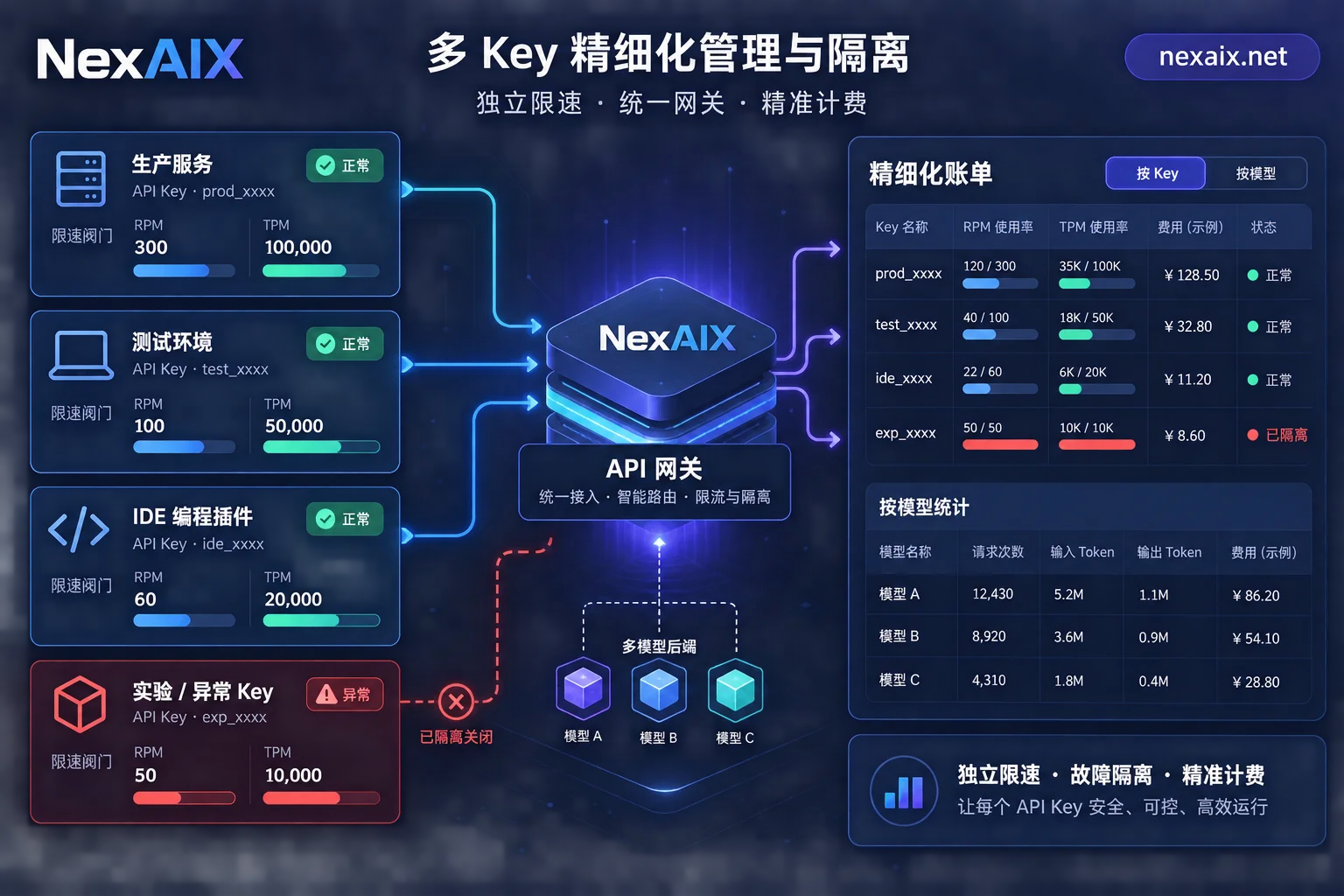
- One key per scenario, independent quotas and permissions: In the NexAIX Console, you can create separate API keys for core production services, internal test pipelines, and each engineer's clients such as Cline / Cherry Studio / Dify. Each key has its own RPM (requests per minute), TPM (tokens per minute), and concurrency limits.
- Second-level loss stopping for failures and leaks: Once a security vulnerability is exposed in an open-source plugin, or an experimental Agent falls into an infinite loop and floods requests, the independent key's rate limit will block the abnormal traffic surge first (returning 429 when exceeded); administrators can also revoke the affected key separately in the console without interrupting core online production services. If normal business growth requires higher throughput, you can always contact us to request a quota increase (see Throughput and Rate Limit Description for details).
- Itemized reconciliation by key and by model: When reviewing ROI at the end of the month, there is no need to guess blindly among mixed total bills. NexAIX supports exporting independent usage bills for each key, with bills itemized by model. Which microservice consumed how many flagship model tokens, and which internal tool used how much open-source model compute—all at a glance.
- Request-level troubleshooting and zero-log privacy protection: Each API call returns a unique request ID and records the model name, token count, timestamp, and status code. When a call's latency or token consumption is found to be abnormal, the technical team can quickly locate the problem with the request ID. Meanwhile, NexAIX strictly implements a no-conversation-logging policy: your prompts and completions are only forwarded in memory via TLS 1.3 encryption, released immediately after the request ends, not written to disk, and never used for training (retention policies after closed-source models reach upstream vendors are subject to each vendor's terms; for example, Claude Opus 5 supports zero data retention, and details are subject to the specific model page).
6. Conclusion: From "Blind Budget Cutting" to "Fine-Grained Compute Governance"
Reducing AI API costs does not rely on reducing AI usage frequency, but on spending every unit of compute where it matters most. Reviewing the entire optimization path, technical teams can complete the transformation within one iteration cycle:
- Unified integration layer: Use
https://api.nexaix.net/v1to unify multi-model calls, eliminating the engineering cost of maintaining multiple SDKs; - Task-layer triage: Core reasoning goes through officially authorized closed-source models, while high-frequency execution goes through open-source weight models deployed on own GPU clusters;
- Channel-layer fidelity: Choose transparent supply that does not downgrade, swap models, or alter parameters, eliminating invalid retries caused by quality degradation;
- Governance-layer isolation: Split API keys by project and tool, use independent RPM/TPM quotas to prevent abuse, and rely on itemized bills to accurately account for the true cost of each business module.
Now, you can simply visit the NexAIX Console (api.nexaix.net) with your email to register. You will receive test credits upon registration, with no cumbersome enterprise qualification approval. With a new key, you can immediately conduct A/B cost stress tests on your Agent workflow. For teams with compliance audit, enterprise contract, and VAT invoice requirements, or those needing to evaluate dedicated resource pools and private deployment, feel free to contact our engineering team at [email protected].


Comments(0)