 NexAIX-官方博客
Enterprise AI API capacity guarantees are not a single switch but a four-tier progression: account-level quotas, shared pool request-level tiers, dedicated compute pools, and private deployment. Only the latter two tiers can typically be written into contracts. The first two affect only queue priority and cost, while the latter two offer hard commitments. The August 11, 2026 agreement between IBM and Together AI is making compute ownership a must-ask in vendor selection. Below, we break down each tier, provide a comparison table, a checklist of contract clauses, and acceptance testing methods.
TL;DR: Enterprise AI API Capacity Guarantees Come in Four Tiers
Enterprise AI API capacity guarantees can be summarized into four tiers: account-level quotas, request-level service tiers in a shared pool, dedicated compute pools, and private deployment. The first two are “soft guarantees,” mainly affecting queue priority and cost without promising absolute capacity; the latter two are “hard guarantees” where compute is explicitly allocated, making capacity metrics suitable for contractual commitments. Most procurement disputes arise from treating soft guarantees as hard ones. Understanding what each tier guarantees and what you see when it fails is essential homework before signing.
Tier 1: What Account-Level RPM/TPM Quotas Guarantee and What They Don't
RPM (requests per minute) and TPM (tokens per minute) quotas are the basic limits on every enterprise AI API account, but they are essentially caps, not floors: they limit how many requests you can send, without promising that the platform will always handle them. When this fails, the typical symptom is: you haven't hit your quota, yet you see 429 rate limits or increased queue latency. During procurement, ask three clarifying questions: Is the quota calculated per account or per API key? Is it measured per minute or on a sliding window? What error code is returned on overage, and can you temporarily raise the limit? If the vendor is vague on these, quota management may not be transparent. For more on concurrency limits and quota definitions, see How to Set AI API Concurrency Limits.
Tier 2: Request-Level Service Tiers in a Shared Pool
When multiple customers share the same compute, vendors offer different priority tiers. For example, DeepInfra offers Priority and Flex tiers on DeepSeek-V4-Pro-0813 (as of August 2026 public settings). The Priority tier gets higher queue priority, but during peak times when the entire pool is congested, it only affects your relative position—it does not mean reserved capacity. Such tiers address queue ordering, not capacity guarantees. Buying Priority doesn't mean an insurance policy against rate limits; it's just a better position in the shared pool. Understanding this prevents mistaking “priority” for “reserved.” Also, parameters like explicit cache retention are cost optimization tools, unrelated to capacity commitments.
Tier 3: Dedicated Compute Pools: Is Dedicated AI API Compute Worth It?
When compute instances are bound to your account, concurrency limits, latency distributions, and maintenance windows become contractable. Top inference providers are now using long-term compute commitments to back enterprise promises (see the time-sensitive reference in the next section). The costs of dedicated pools are also clear: high entry cost, limited elasticity, and expansion requires advance scheduling. They suit core production paths with stable peak loads and latency sensitivity.
Tier 4: Private Deployment
Private deployment is driven by constraints, not performance: data cannot leave the domain, industry compliance requirements, audit trail ownership, and network boundaries with internal systems make API calls impractical. It turns capacity into self-managed operations—you handle scaling, troubleshooting, and peak overflow yourself. Before evaluating private deployment, confirm three things: Can you obtain the model weights compliantly? Does your operations team have model tuning and inference optimization skills? Who handles peak capacity? If any of these are unmet, private deployment could become a new bottleneck.
Why Compute Binding Has Become a Vendor Differentiator
Inference providers are shifting from pure per-token pricing competition to locking in throughput determinism with dedicated hardware. IBM and Together AI's $240 million agreement on August 11, 2026, deploys NVIDIA HGX B300 inference clusters on IBM Cloud. The “30x throughput compared to previous generation” in the press release is an overall capacity figure, not a per-account TPS, concurrency, or latency commitment. As a buyer, this news should become the basis for asking: Is the vendor's compute owned, under long-term contract, or resold at market rates? Compute ownership determines the credibility of capacity promises. When choosing a relay service, refer to How to Choose an AI Relay Service.
Comparison Criteria: What's the Difference Between Dedicated and Shared Pool APIs?
| Option | Cost | Concurrency Limit | Latency Determinism | Fault Attribution | Compliance Audit | Suitable Business Form |
|---|---|---|---|---|---|---|
| Account-level Quota | Low | Low, limited by account | Low, affected by shared pool | Hard, need self-investigation | Weak, limited metadata | Internal tools, prototype validation |
| Request-level Service Tier | Medium | Medium, affected by shared pool load | Medium, Priority improves queue priority | Medium, has priority identifier | Medium, observable priority | C-end peak business, batch processing |
| Dedicated Compute Pool | High | High, independent compute | High, can commit to latency distribution | Easy, compute isolation | Strong, independent audit | Core production, stable peaks |
| Private Deployment | Highest | Self-determined | Self-determined | Full control | Strongest, full control | Strict compliance, data stays on-site |
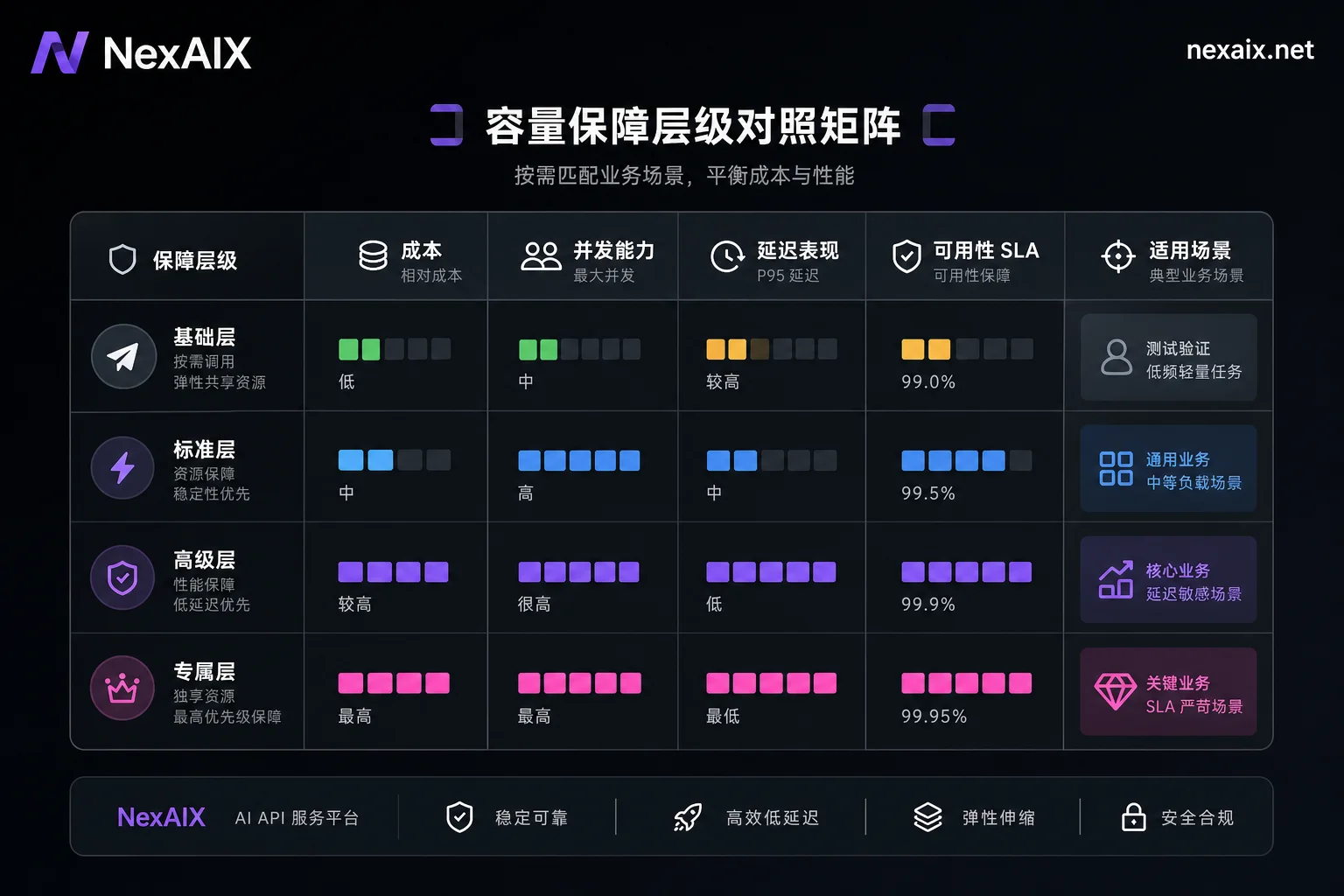 Note: This is a qualitative comparison; specific values depend on vendor public documents and contract terms.
Contract Clauses to Ask Before Signing
Use this checklist in any enterprise AI API vendor discussion.
Quota Definition: Clarify whether quotas are per account or per key, per minute or sliding window, and what error code is returned on overage. Vague answers mean uncontrollable risk.
Degradation Behavior: When overloaded, does it return a standard 429 with retry advice, or silently switch to a cheaper model? This is key to judging vendor honesty.
Model Identification: If the vendor doesn't commit that the model field corresponds to the actual execution model, you can't prove you got the contracted model during peaks—this should be a written commitment.
Billing Alignment: Can the usage summary be aligned line-by-line with the invoice? Can you see token counts and cost details per request?
Fault Responsibility: When problems occur, who provides the log evidence for fault attribution? Does the vendor provide the full chain, or does the customer guess?
In this regard, NexAIX publicly offers enterprise contracts, dedicated compute pool, and private deployment assessments, and explicitly promises: when overloaded, it returns a standard 429 with retry advice and does not silently switch to cheaper models; the model field in responses corresponds to the actual execution model; it retains only necessary metadata like request ID, model name, token count, timestamp, and status code for billing and troubleshooting. These commitments align with capacity audit and billing alignment checkpoints. You can use these three points to verify any vendor—including NexAIX itself.
How to Validate Enterprise AI API Capacity Promises During a Trial
Translating contract promises into repeatable observations is more valuable than measuring peak numbers. Here's how:
- Run a fixed request set with the same OpenAI-compatible code at different times (day, night, promo days).
- Record status code distributions, especially silent failures that aren't 429 (e.g., 200 with erroneous content).
- Check if the
modelfield in responses matches the requested model. - Aggregate usage data and align with the invoice line-by-line to verify billing accuracy.
- Observe whether error responses include usable retry guidance (e.g.,
Retry-Afterheader).
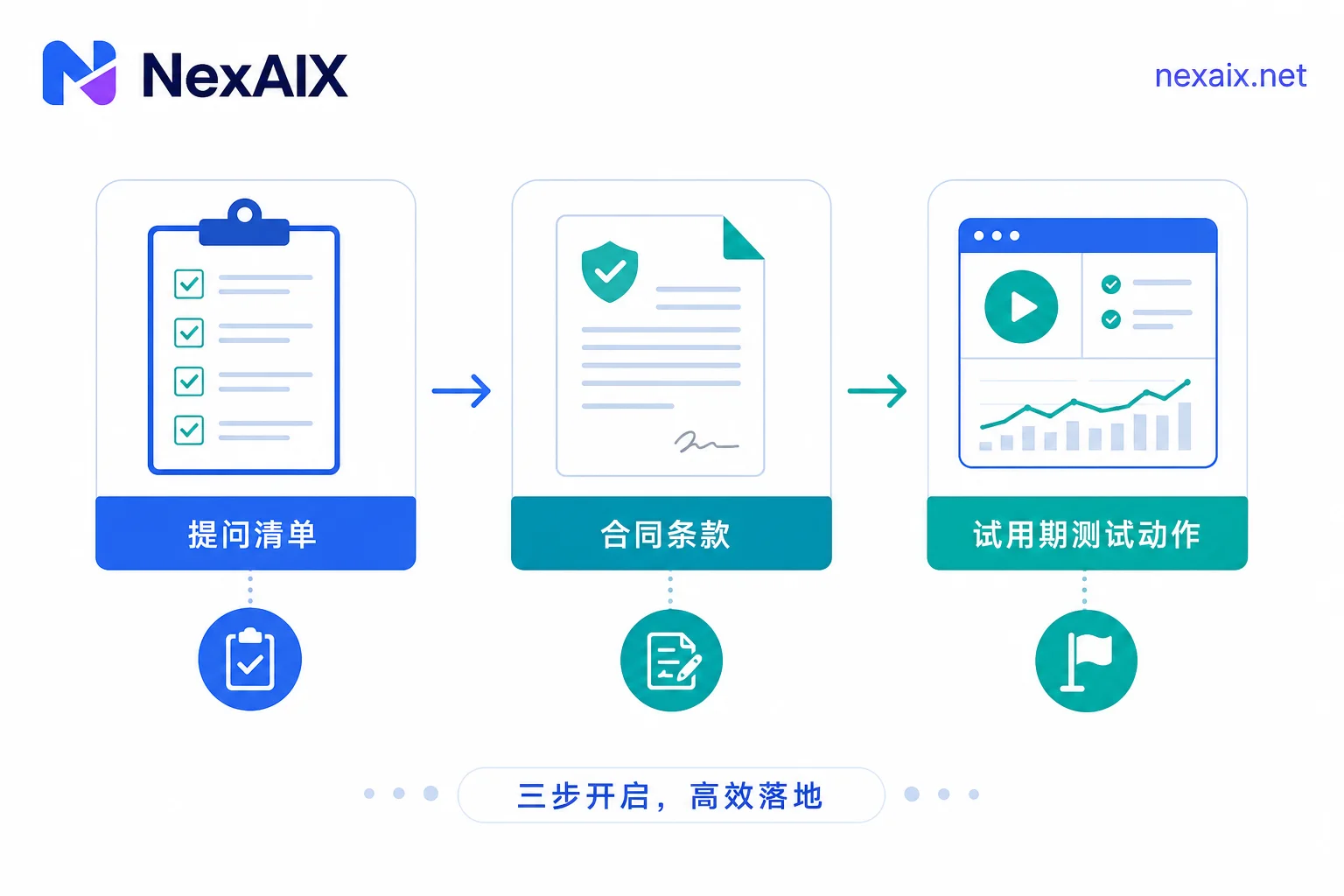 The acceptance goal is not to test throughput limits but to verify behavioral consistency—whether vendor promises hold at any time.
FAQ
Will shared pools always be rate-limited?
Not necessarily. Shared pools may rate-limit under high load, but it depends on the vendor's capacity planning and scheduling. Test during peak hours in the trial to see if you get 429 or increased latency. If the vendor offers a Priority tier, you can buy it and compare, but don't expect it to completely avoid rate limits.
Does a dedicated pool mean no 429s?
Not necessarily. Dedicated pools typically offer more stable capacity, but if your request volume exceeds the pool's actual capacity, you might still see rate limits or queues. The contract should specify concurrency limits and overage handling. Gradually increase concurrency during testing to find the real boundary.
At what business scale should you consider dedicated compute?
When shared pool fluctuations start affecting your own SLA commitments, peak 429 ratios or P95 latency periodically rise, and your peak pattern is stable and predictable, evaluate a dedicated pool. Base decisions on status code and latency distributions recorded during the trial.
Can private deployment and API calls be combined?
Yes, hybrid architectures aren't uncommon. For example, route sensitive requests to private deployment and regular requests to the API. The key is ensuring interface compatibility and data consistency. For more, see AI API Selection.
Can trial credits reveal capacity issues?
Yes, but method matters. Run fixed request sets repeatedly during peak hours, recording status codes and latency distributions. Free credits may be limited, but enough for small-scale validation. Focus on silent degradation or rate limits without hitting quotas. Also see How to Verify Zero-Log AI APIs.
Take this article's checklist into vendor discussions, check NexAIX's rate limits and quota, error code documentation, and status page for current policies. Run a behavioral consistency test with trial credits before deciding on dedicated compute or private deployment.



Comments(0)