 NexAIX-官方博客
On the first day of GLM-5.3 API integration, most existing OpenAI-compatible calls only need to change the model field to glm-5.3 to work; the only thing that will cause immediate errors in old code is if you explicitly pass thinking.type: 'disabled' in the request body. The official documentation update on August 14, 2026, states that GLM-5.3 mandates deep thinking, deprecates the disabled option, and retaining the old syntax will directly trigger parameter errors. Below, we follow the three-step approach of "assess first, change parameters, then verify" to minimize migration costs.
GLM-5.3 API Integration: First Assess Which Calls Can Run with a Simple Model Name Change and Which Will Error Out
First, identify your situation: have you ever written the thinking field in your request body? If not—congratulations, you are mostly safe; change model to glm-5.3. If you have, and the value is disabled—it will definitely error, as this is the only breaking change. If you have written it but the value is enabled—it won't error, but we recommend re-tuning according to the new tiers below.
| Request Body Current State | Is It Blocking? | Action |
|---|---|---|
No explicit thinking field | No | Simply change model to glm-5.3, then consider tuning after it runs. |
Explicit thinking: {type: 'disabled'} | Yes | Remove this field or change to enabled, otherwise a parameter error will occur. |
Explicit thinking: {type: 'enabled'} | No | Can continue to use, but recommend switching to reasoning_effort to control intensity. |
No thinking but set reasoning_effort | No | The new parameter is in effect; choose low/high/max based on scenario. |
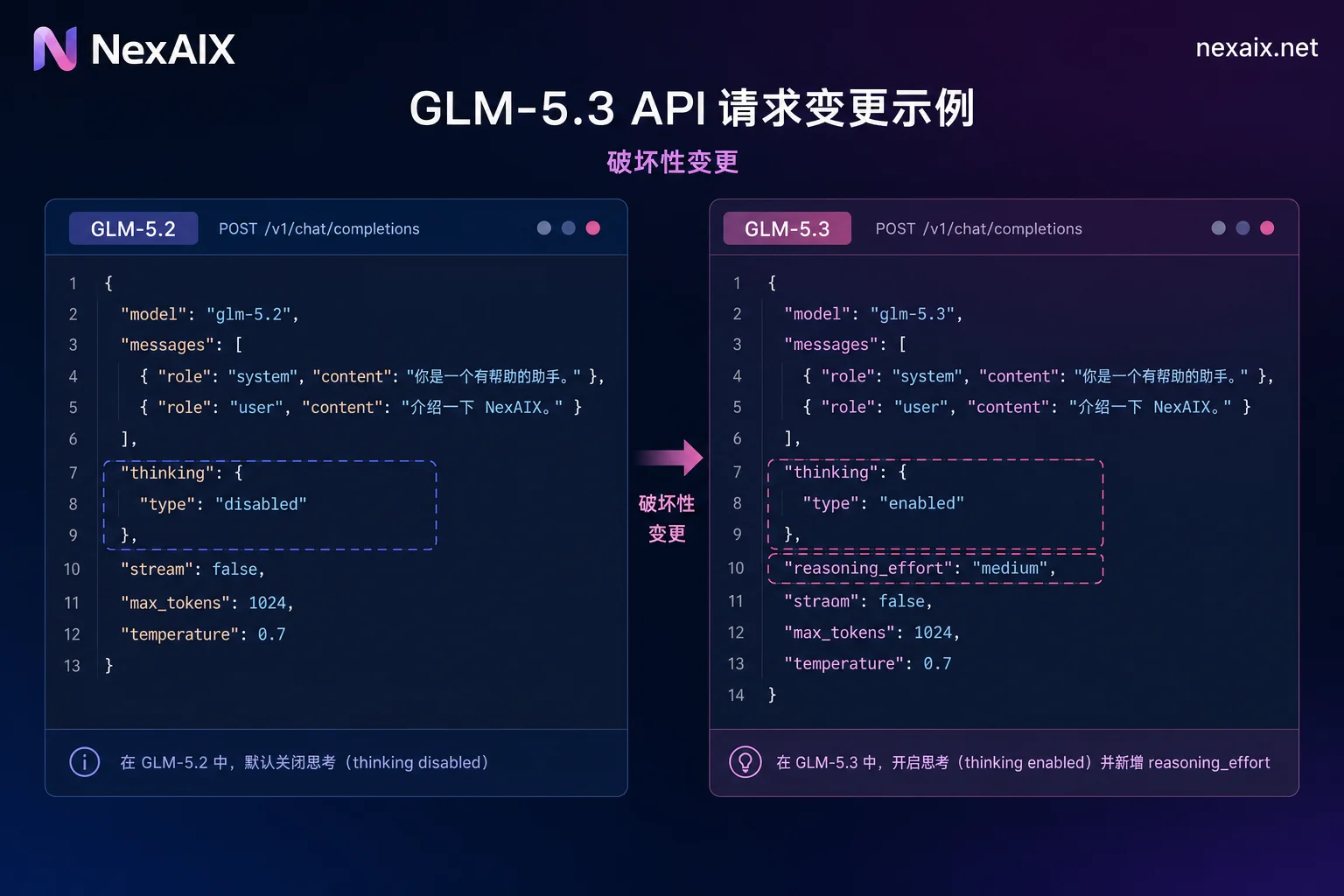
Breaking Change Explained: After Deprecating thinking.type='disabled', How Do the Three Tiers of low/high/max Map to the Old On/Off Logic
In the past, on GLM-5.2, to save tokens or reduce latency, you might have explicitly sent thinking.type: 'disabled' to disable thinking. On GLM-5.3, this path is completely blocked—the model now mandates persistent deep thinking, and you can only adjust computational investment through reasoning_effort across low/high/max tiers. The official documentation explicitly states that the original disabled option is no longer supported.
When migrating from a binary switch to three intensity tiers, we suggest mapping by scenario: use low for low-latency interactions (e.g., simple Q&A, classification), high for routine code completion and Agent tool calls, and max for complex long-chain reasoning (multi-step planning, deep debugging). Note: the higher the tier, the greater the first-token latency and reasoning token consumption typically, but the official documentation does not provide specific millisecond values or token multipliers for each tier—you need to measure based on your task. Additionally, reasoning content and final answers are returned separately; your parsing logic must correctly distinguish between the two to avoid mixing thought processes into the final output.
Does GLM-5.3 Support OpenAI Compatible APIs? Cost Comparison Across Three Protocol Endpoints
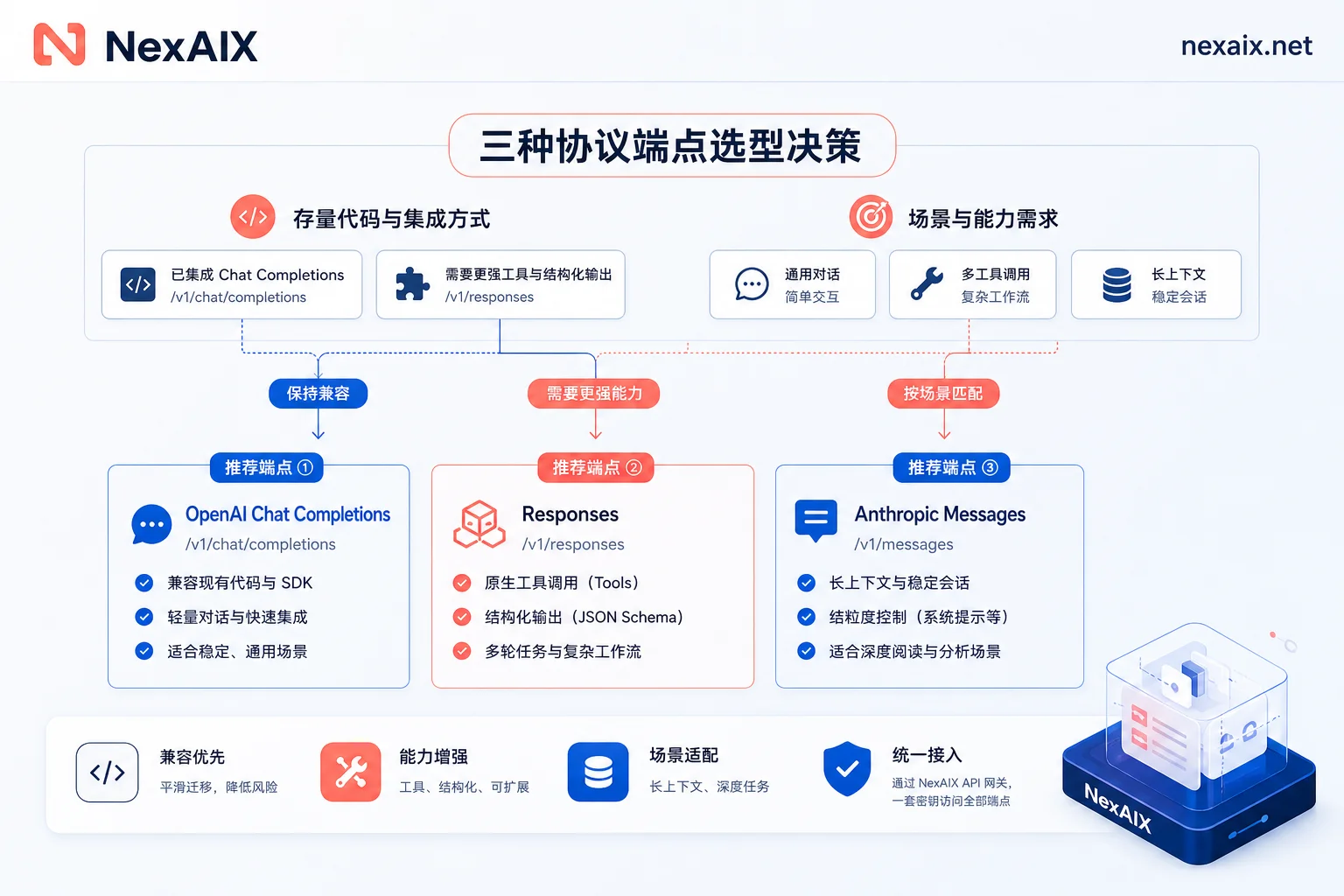
GLM-5.3 offers three official pathways; choose based on your existing code and team habits. The principle is: do not switch protocols and models simultaneously out of curiosity, otherwise, if an error occurs, it will be difficult to determine whether it's an adaptation issue or a model behavior change.
| Endpoint Type | Suitable Scenarios | Key Changes | Notes |
|---|---|---|---|
| OpenAI Chat Completions | Existing OpenAI SDK / codebases | Only change base_url and model; best compatibility | Reasoning content chunking; verify tool call arguments parsing |
| OpenAI Responses | New projects requiring more structured reasoning process | Request/response structure differs; SDK adjustments needed | Suitable for teams wanting to deeply utilize reasoning process for orchestration |
| Anthropic Messages | Already using Claude SDK or Agent frameworks | Need to adapt message format and tool call specifications | If framework does not support streaming reasoning, degrade gracefully |
The tool calling and streaming support details vary across the three endpoints; we recommend confirming in official docs whether the features you need are available on your target endpoint. If multiple protocols coexist in your team, unify the entry point during GLM-5.3 API integration to reduce maintenance costs.
Token Budget Control Under 1M Context and 128K Output: How Mandatory Thinking Changes Your Bill
GLM-5.3 supports a 1M context and 128K max output, which sounds great, but mandatory persistent thinking means reasoning tokens also count toward consumption—so the old way of using disabled to control costs is no longer effective. Official release day (2026-08-14) data shows that programming tasks consume on average about 50,000 tokens per task. This magnitude directly determines your budget ceiling.
Three actions to control budget: first, set a reasonable max_tokens per scenario to prevent unbounded expansion of single requests; second, route by scenario using reasoning_effort—use low for light tasks and escalate to high or max only for heavy tasks; third, run a set of representative tasks before and after the switch to compare per-request token counts and latency, and calculate the cost delta. Note: official per-use pricing has not yet been announced; currently you can only estimate relative costs via credit quotas. For long-term budgets, wait for the pricing page update for precise calculations.
Realistic Boundaries of Access Paths: Coding Plan Credits, Off-Peak Discounts, Pay-As-You-Go, and a Two-Week Open Source Buffer
To answer "how can I call it now": launched on August 14, GLM-5.3 is fully available via the GLM Coding Plan subscription (Personal/Team), with quota reset for all users at 13:00 that day; off-peak hours (including weekends) receive a 50% discount on credits. Pay-as-you-go commercial APIs are rolling out in batches, but the exact per-million-token price has not been announced. Third-party aggregation platforms (e.g., SiliconFlow, OpenRouter) have varying adaptation timelines; currently, the main routes are official subscription channels or integrated parties (e.g., OpenClaw's provider). The full model weights are planned to be open-sourced within two weeks after security hardening; for self-hosted deployment, you must wait for the weights to be released. So, if your team already has a Coding Plan, you can start small-scale pilot testing now; if you rely on pay-as-you-go or self-hosting, we recommend waiting for official billing and weight release before full migration.
Is It Worth Switching? Use Benchmarks and Single-Task Token Consumption for Magnitude Judgment, Not Blind Trust
GLM-5.3 and GLM-5.2 share the same base with ~743 billion parameters; performance gains come entirely from post-training scaling (reinforcement learning with IndexShare, SAO, Slime frameworks). Publisher-announced Z.ai Code Bench improvements over the previous generation are 50%, with 31.4% accuracy on High tier; Terminal-Bench 3.0 / DeepSWE v1.1 / Agents Last Exam all set new records for open-source models (official data as of 2026-08-14).
Note that these benchmarks are self-built by the publisher, not independent third-party evaluations, so treat them as rough reference points. The correct approach is to run your own task set for comparative evaluation, focusing on two dimensions: per-task token consumption and accuracy. According to official statements, comparing 50k tokens to 120k tokens means the same budget can run 2x more tasks, which is the most valuable incremental point to verify.
Regression Checklist to Run After Integration: Tool Calls, Streaming Output, Long Context Truncation, Error Codes, and Cost Delta
Migration is not over after changing parameters; we suggest verifying each item on this checklist:
- [ ] Normal requests without the
thinkingfield return correctly - [ ] Send requests with no thinking parameter and with enabled, confirm both do not error
- [ ] Run one group for each of the three
reasoning_efforttiers (low/high/max), record first-token latency and total token counts - [ ] For tool calls, check that
argumentsparsing is complete and tool selection is correct - [ ] In streaming chunks, ensure boundaries between reasoning content and final answers are clear
- [ ] With long inputs near 1M context, confirm truncation behavior matches expectations
- [ ] Timeout and rate-limit error code branches are handled (refer to AI API 429 troubleshooting)
- [ ] Run 10 representative tasks before and after the switch, compare per-request token counts and latency, calculate cost delta
This checklist will help you catch most compatibility issues before going live, avoiding carrying failures into production.
Run Comparative Evaluations Across Multiple Models Using the Same OpenAI-Compatible Codebase
Given varying third-party adaptation timelines, a more robust engineering approach is to make the base_url and model fields configurable, and use a unified OpenAI-compatible entry point (e.g., NexAIX's https://api.nexaix.net/v1) to run the same regression set across models like GLM, DeepSeek, and Kimi. This minimizes switching costs and facilitates horizontal comparison. For more on OpenAI-compatible model migration paths, refer to this practical note; when evaluating costs, AI API cost optimization can help you build a more granular budget model.
A reminder: before going live, check the NexAIX model page and changelog for the current availability, context specs, and billing of GLM-5.3; release-day benchmarks are not long-term commitments.
FAQ
How to fix the GLM-5.3 thinking disabled error?
Delete the thinking: {type: 'disabled'} section entirely from the request body, or change it to enabled. GLM-5.3 forces thinking on; the old value is deprecated, and not removing it will cause a parameter error. After changing, restart your client and verify with a normal request.
How to set GLM-5.3 reasoning_effort?
Three tiers: low for low-latency simple tasks, high for regular programming and Agent tasks, and max for complex reasoning. Route by scenario; avoid using max for light tasks, or token usage and latency will increase. The official docs do not specify precise values for each tier; we recommend testing and devising your own strategy.
What parameters need to change when moving from GLM-5.2 to GLM-5.3?
Core changes: change the model field to glm-5.3, delete the disabled configuration from thinking, and add reasoning_effort as needed. Other OpenAI-compatible fields remain largely unchanged, but your parsing logic must accommodate the separated reasoning content.
Does GLM-5.3 support the OpenAI compatible interface?
Yes, the official API provides three endpoints: OpenAI Chat Completions, Responses, and Anthropic Messages. Existing OpenAI SDK users can simply change the base_url and model; compatibility is best.
What are the context and maximum output for GLM-5.3?
Official documentation indicates support for 1M context and 128K max output. However, actual output length is also affected by the max_tokens setting, and long context inputs require verification of truncation behavior.
When will GLM-5.3 open source weights be released?
The official plan is to open source within two weeks after security hardening, i.e., approximately by August 28, 2026. Third-party platforms typically bring up self-hosted nodes after weights are released; currently, the main channel is the official Coding Plan.


Comments(0)