 NexAIX-官方博客
In the second half of 2026, DeepSeek's model iteration pace has clearly accelerated. From the DeepSeek-V4 preview released in the first half, to the official V4-Pro in August, and then the native multimodal model DeepSeek-V4.1-Flash and its 1017 upgrade (DeepSeek-V4.1-Flash-1017) launched in September and October, DeepSeek has once again pushed the Pareto frontier in code engineering (SWE), agent automation, and multimodal understanding.
However, along with architectural innovations come frequent API endpoint changes and stricter cloud service capacity governance. For technical leads and agent development teams maintaining production workloads, how to benefit from new models while avoiding pitfalls such as retired endpoints, account-level concurrency limits, and "hidden downgrades" from low-cost third-party channels has become the core engineering challenge.
This article combines the latest DeepSeek model evolution to provide a complete implementation guide covering model selection, smooth code migration, concurrency limit management, and production-grade compute infrastructure selection.
I. 2026 DeepSeek Model Evolution and API Endpoint Adjustments
Over the past two years, many developers hard-coded deepseek-chat or deepseek-reasoner in their code. But in the 2026 product line evolution, DeepSeek's model matrix and naming conventions have undergone significant adjustments:
- Retirement of legacy model names and automatic routing: The original
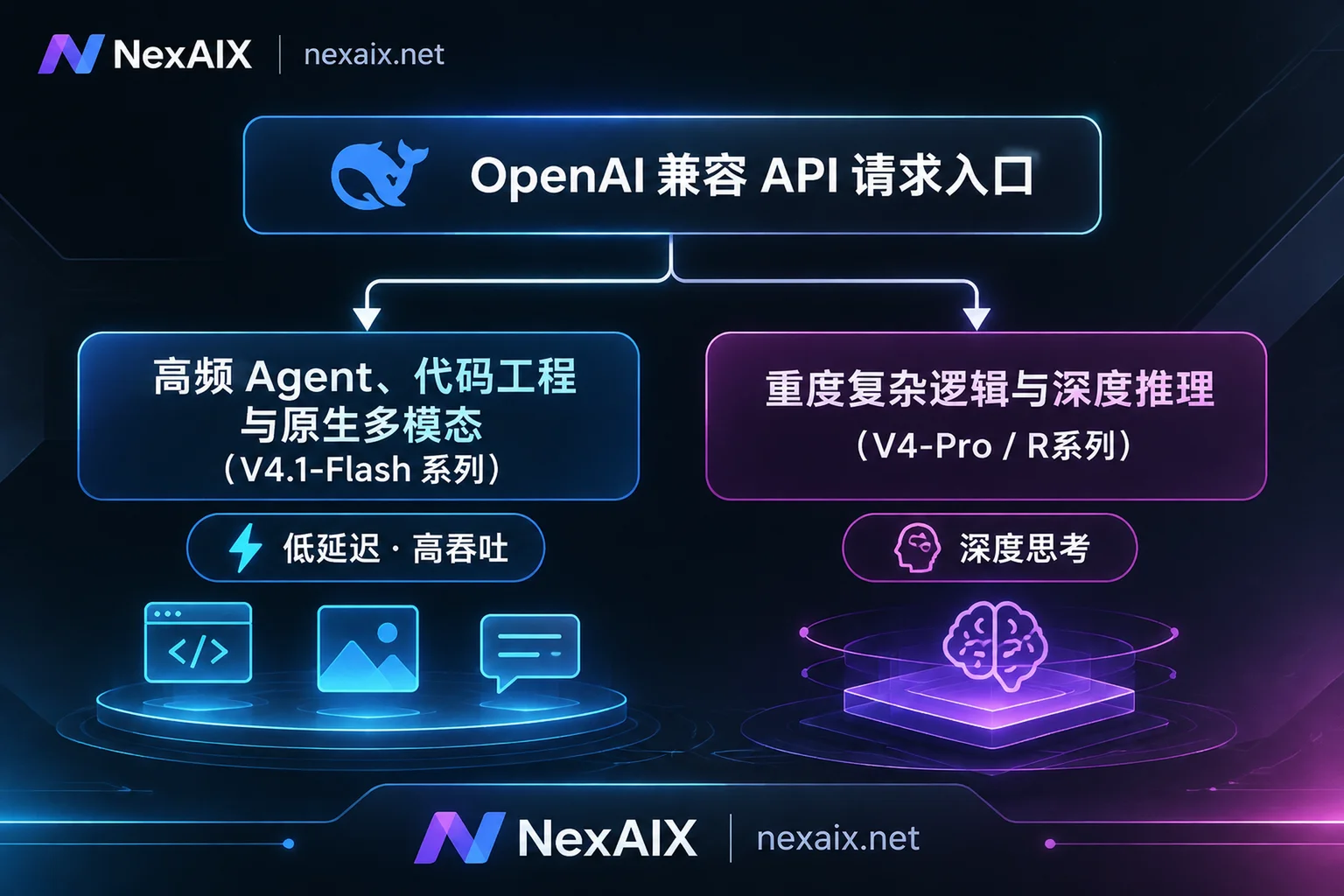
deepseek-chatanddeepseek-reasonerwere retired in late July 2026. After the September release of DeepSeek-V4.1-Flash with its new asymmetric Causal-Encoder-Decoder architecture (552B total parameters, 8B input activation, 16B output activation), the earlydeepseek-v4-flashand vision experimental versiondeepseek-v4-flash-vision-expwere also taken offline and temporarily routed to V4.1-Flash (API model namedeepseek-flash). - Division of labor between V4.1-Flash-1017 and V4-Pro: The mid-October update V4.1-Flash-1017 made significant leaps on code and agent benchmarks such as DeepSWE and Terminal-Bench, while reducing task runtime and output length, offering extremely high throughput and cost-effectiveness, and native support for multimodal visual understanding; DeepSeek-V4-Pro remains available for scenarios requiring heavy expert-level reasoning.
In practical business selection, if you have previously read our Kimi API Integration and Migration Guide or GLM API Integration and Selection Guide, you will notice that mainstream domestic large models are all converging toward native multimodal and high-throughput agent models. Before integration, it is recommended to verify the exact model ID, context window, maximum output, and input modalities of the target model.
II. Three High-Frequency Pain Points When Integrating DeepSeek API in Production
When business moves from local demos to high-concurrency production environments (especially batch data processing and multi-step agent orchestration), development teams commonly hit three walls:
1. Account-Level Concurrency Limits and Long-Chain Blocking
As call volumes explode, DeepSeek's official service has entered a standard cloud service rate-limiting governance phase. According to its rate-limiting rules, concurrency limits are calculated at the "account granularity", not per API Key. This means creating multiple keys under the same official account for polling cannot exceed the total concurrency limit.
For typical Q&A applications, hundreds of concurrent requests are more than enough; but for agent platforms (where a single user command triggers a dozen tool calls, code verification, and long chain-of-thought reasoning in the background) or batch cleaning tasks, long-context and long-output requests occupy concurrency slots for extended periods, easily triggering HTTP 429 (rate limit exceeded) or, during evening peak hours, HTTP 503 (server busy) due to global overload.
2. Behavior Drift Caused by Model Routing Changes
As mentioned earlier, when upstream automatically routes old model names to new models, or in some non-standard relay channels where providers secretly switch heavy reasoning requests to lightweight models to handle peak traffic, carefully tuned prompts and function-calling parsing logic on the business side may encounter format errors or output quality fluctuations.
3. "Quantization Downgrades" and Logging Risks in Third-Party Resale Channels
DeepSeek adheres to an open-weight approach, which has led to a proliferation of API aggregation and resale sites of varying quality. Some low-cost channels have three major hidden risks:
- Accuracy shrinkage: Running high-precision reasoning tasks on excessively quantized weights while billing at original rates.
- Hidden truncation: Secretly compressing maximum context window or
max_tokens, causing long document analysis tasks to lose beginning or end content. - Unclear log retention: Requests pass through multiple layers, and enterprises' core codebases and business prompts risk being stored and leaked or used for fine-tuning training.
For how to identify and avoid these underlying traps, refer to our previous How to Choose Open-Source LLM API: Pitfall Avoidance Guide from Self-Built Clusters to Low-Cost Resale to Production-Grade Hybrid Calls.
III. Why Engineering Teams Choose NexAIX to Call DeepSeek and Hybrid Models
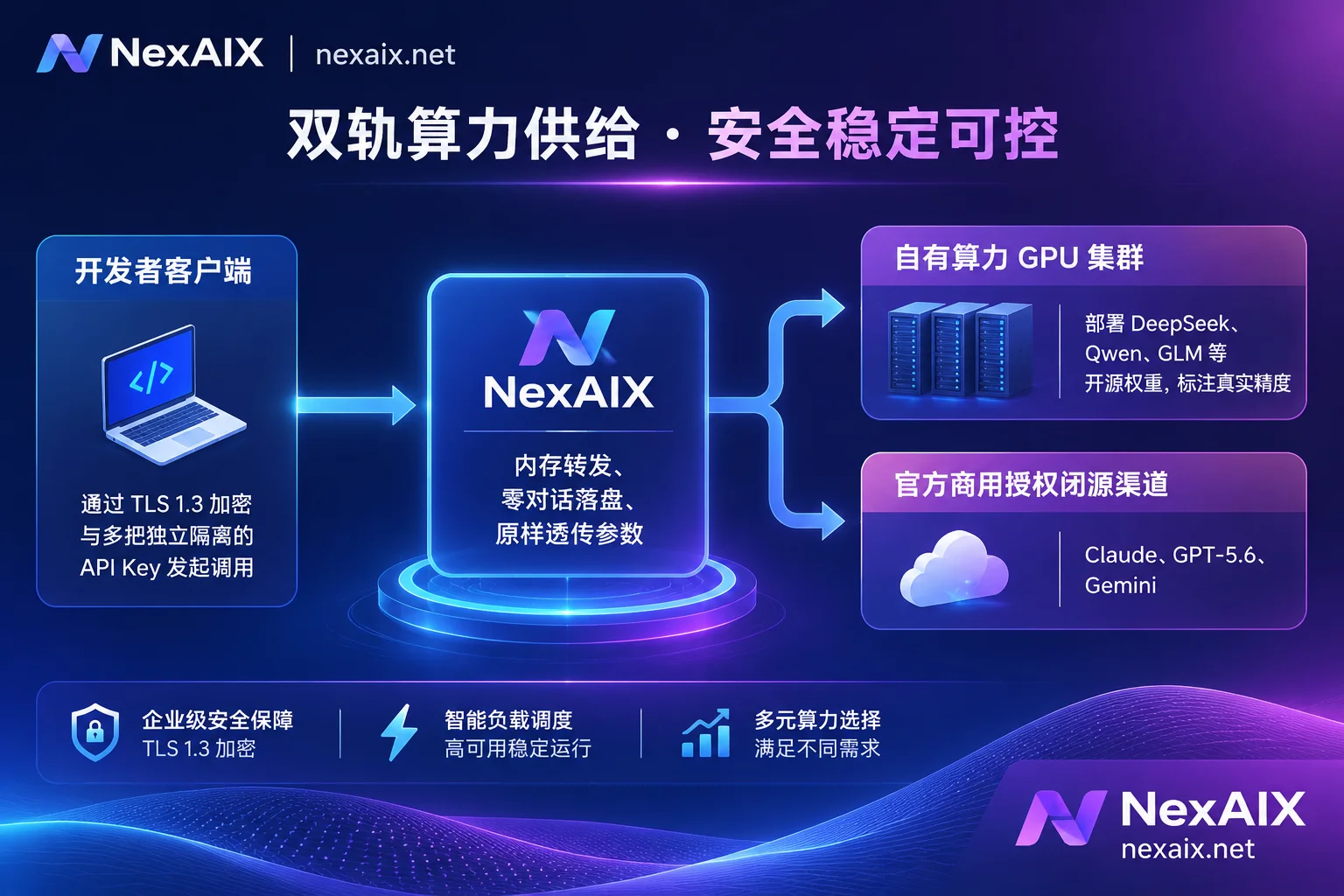
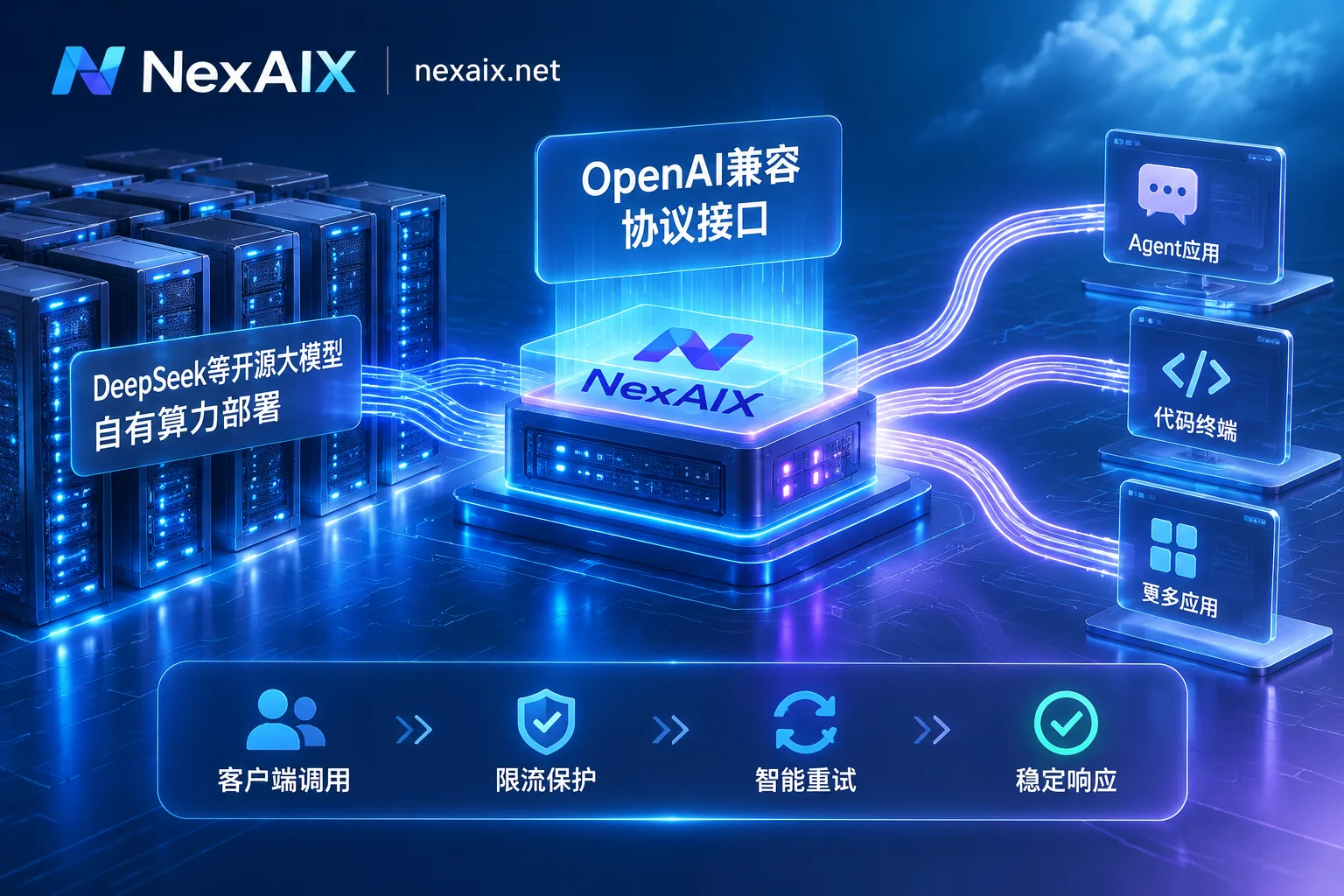
To address the above production pain points, NexAIX (nexaix.net) provides a standard, transparent engineering solution. We do not engage in multi-layer resale, nor do we use reverse protocols or account pools; instead, we offer production-grade API infrastructure through two clear supply methods: private compute deployment and officially authorized channels.
1. Private Compute Cluster Deployment with Fully Transparent Specs and Precision
On NexAIX, open-weight models including DeepSeek, Kimi, GLM, MiniMax, Qwen, and gpt-oss are all deployed on private compute:
- Self-built and leased data center operations: We deploy official open weights directly on our own GPU clusters, handle underlying operations ourselves, and never resell third-party quotas.
- Publicly verifiable parameters: On each individual model page in the NexAIX Model Hub, we clearly indicate the supply method (
自有算力部署), publisher, open-source license, context length, maximum output, input modalities, and actual inference precision (e.g., BF16, FP8, MXFP4, etc., all annotated per model based on actual deployment). - Custom scheduling on demand: If your team needs to call a specific open-weight model not currently listed (e.g., a specific historical DeepSeek weight version), you can send the model name and estimated usage to
[email protected], and we will evaluate compute capacity and reply with an onboarding schedule.
(Note: For currently online specific DeepSeek sub-models, inference precision, and pricing, please refer to the real-time page at https://nexaix.net/models/; when visiting an individual model detail page, note that the URL slug rule replaces dots in the model ID with hyphens.)
2. Strict "Four No-Downgrade" Commitment, Supporting Developer Self-Verification
To ensure production determinism, NexAIX adheres to a strict no-downgrade principle:
- The
modelfield in the response body is the model that actually performed inference; we do not swap to smaller models, do not reduce precision, do not truncate context or maximum output, and do not inject hidden system prompts. - Hyperparameters you pass, such as
temperature,top_p, andmax_tokens, are passed through to the inference node as-is. - We encourage technical teams to independently verify using four methods: re-testing with fixed prompts and random seeds, checking the returned
modelfield, stress-testing near the upper length limit, and asking the model to repeat all received messages (see How to Confirm Whether the API Returns the Original Model: Four Verifiable Check Methods).
3. In-Memory Forwarding and Zero Conversation Logs
Code completion and internal enterprise agents often involve highly sensitive data. Regarding zero logging and privacy protection, NexAIX ensures on our side:
- No disk writes, no training: All
promptandcompletionare forwarded only in memory and released immediately after the request ends, never written to disk; data is not used for model training and is never handed to any third party for training. - End-to-end encryption and minimal metadata: TLS 1.3 encryption is used from client to inference node; the system retains only request ID, model name, token counts, timestamps, and status codes for billing and troubleshooting.
4. Per-Key Isolation and Clear 429 Boundary Control
Unlike the restricted mode of a single account sharing a concurrency pool, NexAIX supports per-key isolation:
- Each API Key has independent quotas (RPM, TPM, and concurrency limits), independent permissions, and independent usage billing. If a test key leaks, it can be revoked separately without affecting the production main chain; for financial reconciliation, bills are itemized clearly by model.
- When concurrency reaches the limit or the cluster is fully loaded, NexAIX returns a standard HTTP
429status code with aRetry-Afterresponse header, never hanging connections indefinitely, and never arbitrarily downgrading your request to a cheaper model (for details, see High Throughput and Rate Limiting Mechanisms). - If your production business requires higher RPM/TPM or concurrency quotas, you can submit a request at any time, and we will respond quickly based on actual cluster capacity.
IV. Integration in Practice: Three-Step Migration and Hybrid Model Scheduling Example
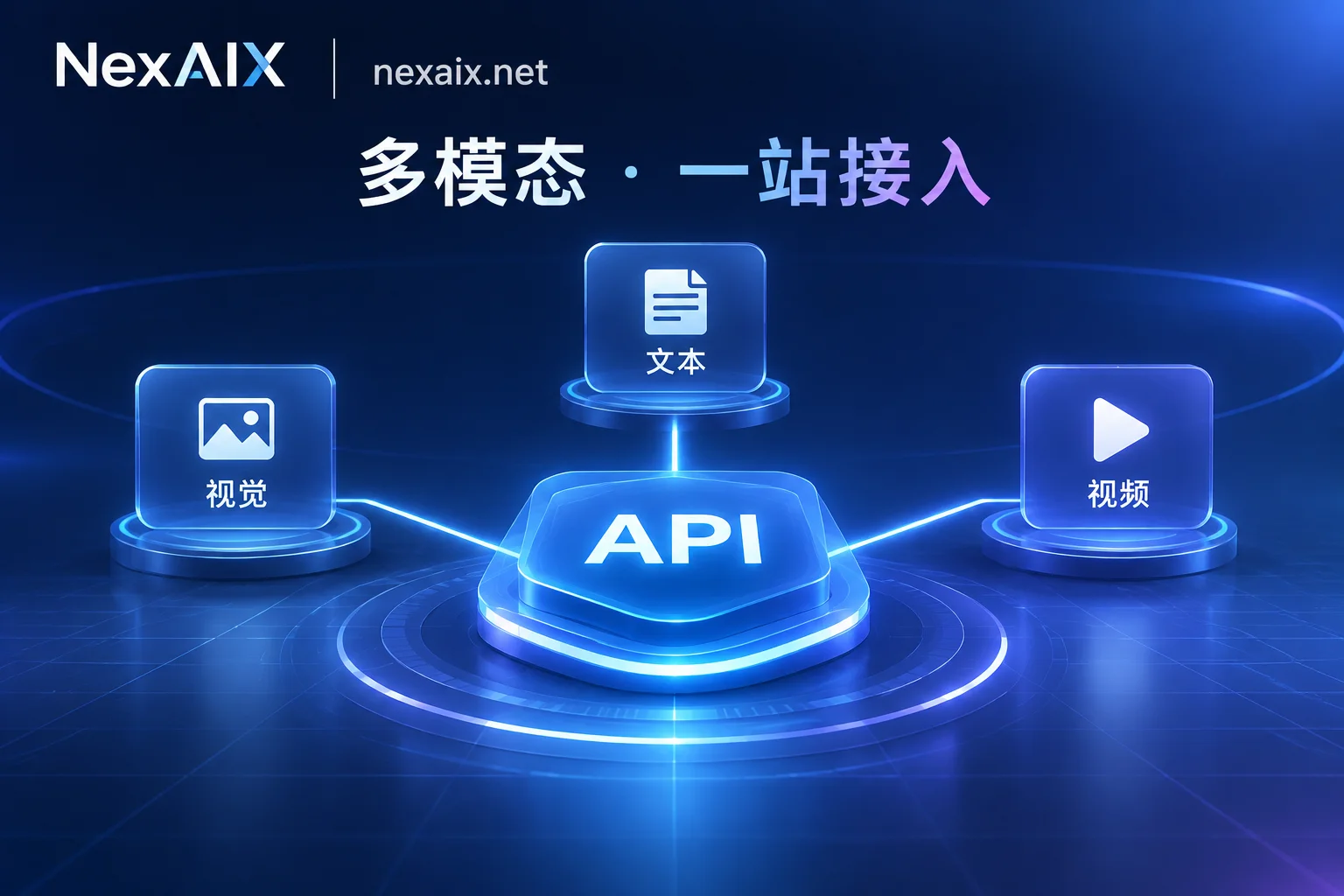
NexAIX is fully implemented according to the OpenAI Chat Completions specification, supporting streaming, function/tool calling, and multi-turn conversations. For multimodal models, images can be passed in standard OpenAI format as image_url or base64 (videos can be passed as sequences of extracted frames).
If your existing project already uses the OpenAI SDK, or is using mainstream tools such as LangChain, LlamaIndex, Vercel AI SDK, Dify, Cherry Studio, NextChat, Cline, OneAPI, you only need to change base_url and api_key for seamless integration (see One-Click Replacement Integration Instructions).
1. Python SDK Integration and Standard 429 Backoff Handling
In production, since NexAIX does not perform hidden "automatic failover or model swapping" for users, we recommend implementing explicit backoff or cross-model switching strategies on the client side in combination with Retry-After. Below is a standard Python example:
import os
import time
from openai import OpenAI, RateLimitError

# 1. 仅需将 base_url 指向 NexAIX 端点,换上控制台获取的 API Key
client = OpenAI(
    api_key=os.getenv("NEXAIX_API_KEY"),
    base_url="https://api.nexaix.net/v1"
)

def call_model_with_retry(messages, model_id, max_retries=3):
    for attempt in range(max_retries):
        try:
            response = client.chat.completions.create(
                model=model_id,  # 请填写 https://nexaix.net/models/ 页面标注的实际模型 ID
                messages=messages,
                temperature=0.6,
                max_tokens=4096,
                stream=False
            )
            # 可核对 response.model 确认实际执行模型,记录 response.id 便于排障
            print(f"[Success] Request ID: {response.id} | Executed Model: {response.model}")
            return response.choices[0].message.content

        except RateLimitError as e:
            # 遇到满载或触发当前 Key 的配额上限时,读取标准 Retry-After 头进行退避
            retry_after = int(e.response.headers.get("Retry-After", 2 ** attempt))
            print(f"[429 Rate Limited] Waiting {retry_after}s before retry...")
            time.sleep(retry_after)

    raise RuntimeError("Max retries exceeded.")
Troubleshooting tip: Each call returns a unique Request ID. If you encounter an exception in production, simply contact support with that Request ID to quickly locate the link status without exposing any conversation content.
2. Building a "DeepSeek + Closed-Source Flagship" Agent Hybrid Architecture with One Key
In complex software engineering agents (e.g., based on Cline or custom workflows), betting on a single model is often not optimal. Through NexAIX, you can use the same API Key and the same endpoint to freely switch between open-source models on private compute and closed-source flagship models (such as Claude, GPT-5.6, Grok, Gemini series) from officially authorized channels—switching models only requires changing one model field:
- High-frequency subtasks and batch preprocessing: Route to DeepSeek series models on private compute, leveraging their excellent code generation capabilities and high cost-effectiveness for massive log parsing, unit test generation, and initial retrieval.
- Core architecture refactoring and cross-module debugging: When encountering extremely complex logic loops or requiring zero-data-retention closed-source capabilities (e.g., Claude Opus 5 accessed via our official authorized channel supports upstream zero data retention), simply switch the
modelparameter in the request to the corresponding closed-source model ID.
For how to finely control budgets through multi-model tiering and multi-key billing, we welcome you to read AI API Cost Optimization Practical Guide: From Agent Multi-Model Tiering and Hidden Loss Troubleshooting to Multi-Key Billing Governance.
V. Summary and Quick Start
The continuous evolution of DeepSeek's architecture brings stronger reasoning and multimodal capabilities to developers, but production stability ultimately depends on the transparency of underlying compute supply and the standardization of engineering governance.
- Individual developers and agile teams: Go to the NexAIX Console (api.nexaix.net) now—register with your email to receive free trial credits, with no cumbersome enterprise qualification review; after logging in, you can create independent API Keys, view the model list, and export usage details at any time.
- Enterprise and compliance scenarios: NexAIX has a complete legal entity, supports contract signing and invoicing, and can sign formal Service Level Agreements (SLA) and Data Processing Agreements (DPA). If your business has extremely high requirements for throughput and isolation, we also support negotiating dedicated resource pools and private deployment solutions. Feel free to email [email protected] to contact our engineering team.


Comments(0)